

Perplexity, in partnership with Nvidia, has moved its artificial intelligence agent application Computer to the PC platform – in this version it’s called portable computer. To run it you will need a suitable machine and fairly expensive equipment.
Photo credit: Rubaitul Azad/unsplash.com
The easiest way is to buy an Nvidia DGX Spark desktop running DGX OS; a PC running Ubuntu on an Arm or x64 processor with an Nvidia RTX series graphics card and at least 24 GB of video memory will also work. The DGX Spark sells for $4800, while for the older GeForce RTX 3090 you’ll have to pay over $1500. Due to the memory shortage, we can’t expect more moderate prices in the foreseeable future.
Moving AI agents to PCs requires more than just replacing cloud models with more compact ones. The application must be able to read and edit files, run shell commands, process PDFs locally, and connect to external services; running the AI agent also requires a local sandbox. To implement all of these features, the company had to almost completely rethink the stack—most of the engineering work went into the hardware configuration. The model still requires scheduling tasks, calling tools, and performing multi-step operations, all with fewer parameters than the cloud-based models Perplexity typically uses.
The orchestrator that supports the agent cycle is deterministic code rather than an AI model: the local AI model proposes actions, and the orchestrator generates context, enforces policies, and executes approved tool calls in an operating system-level sandbox. The sandbox restricts processes, file system paths, and network access; if the sandbox is not available, the development environment will be disabled before tool calls are made, and applications will not run them outside the sandbox.
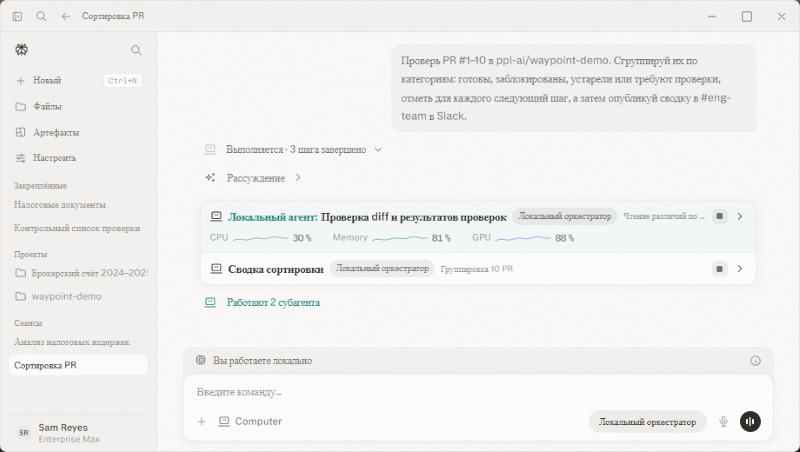
Image source: perplexity.ai
The development environment is designed with the practical limitations of the model context in mind – for Alibaba Qwen3.8-27B this is technically 260,000 tokens, but in practice the model starts to struggle at the 100,000 token mark. As a result, laptops keep the main interface and toolset small; loading additional skills only as needed. Commonly used connectors have been moved to command-line tools instead of direct MCP calls.
The developers tested the computer against the Pi and Hermes agent frameworks. In the 53-question local knowledge workbench, the computer platform scored 82.6%, compared to 77.6% for Pi and 74% for Hermes; in the ParseBench-100 task of dealing with diagrams, layouts, tables, text, and formatting, the computer platform showed 65.1%, Hermes – 34.6%, and Pi 13.9%. When running a laptop, each task is run locally on the device; if the local model cannot complete a step, it can ask the cloud for advice: the system selects context, flags sensitive messages, shows the user what will be sent to external resources, and asks for confirmation before calling.
The laptop has connectors for Google Drive, Gmail, Slack, and GitHub. Obviously, network searches and connector calls occur through connections to external resources; processing of inference models and private documents remains on the PC. The portable computing platform should not be confused with previously released PC applications for Microsoft Windows and Apple macOS. The Alibaba Qwen3.8-27B and PPLX 27B models are available in the initial phase – special versions of the first model with additional training in Perplexity; support for Nvidia Nemotron 3.5 Lightning will come later; users can also connect their own models. The laptop doesn’t yet run on Apple Mac computers; a Windows version is planned for September.
If you find an error, select it with your mouse and press CTRL+ENTER.