



Russian company “3D Research and Development” propose Full-scale design model of the second stage of the private ultra-lightweight launch vehicle “Voronezh”. The demonstration took place at the United Engine Company’s booth at the Technoprom exhibition in Novosibirsk. The model was built at 1:1 scale and was designed to test the layout, test the fastening of the propulsion system and other structural elements.
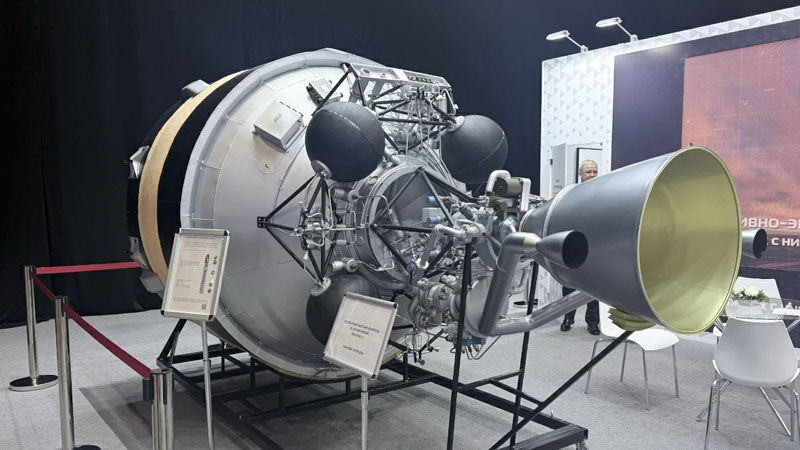
Image source: Rostec
The Voronezh launch vehicle is being developed to launch small spacecraft into low Earth orbit. It is designed to deliver a payload weighing at least 250 kilograms into an orbit at an altitude of approximately 500 kilometers from the Vostok Launch Site. The total mass of the rocket is 36 tons and the length is 20.6 m. The design consists of two phases. The dimensions of the second stage are 4.1 m long and 2.05 m in diameter. RG-1 kerosene (naphthyl) and liquid oxygen will be used as fuel components, which correspond to a common fuel pair in modern Russian rocket technology.
Voronezh’s propulsion system was developed by UEC-Kuznetsov Enterprises, a subsidiary of United Engine Corporation. The rocket will use NK-3 liquid engines, each with a thrust of about 4.5 tons. The first phase will receive 12 such engines. The second stage is equipped with an NK-3, equipped with high-altitude nozzles and capable of dual-engine launch. Some first-stage engines and second-stage engines will be equipped with thrust vector control systems to adjust the flight path of the launch vehicle. This design makes it possible to create a relatively lightweight launch vehicle for the small satellite market and provides more flexible use of the rocket for commercial launches.
The Voronezh program became one of the first examples of privately developed space rockets in Russia and received official approval from industry players. The main investors are Interros-backed Voskhod Venture Fund and NTI Sovereign Technology Fund. The total investment attracted is about 280 million rubles. In the spring of 2026, the preliminary design of the rocket was approved by TsNIIMash JSC, the general scientific research agency of Roscosmos. This is the first time that such a plan has been approved by a Russian private company.
If all goes according to plan, the ignition test of the new engine will take place in late 2027, and the first launch of the rocket will take place in December 2029. At the Vostok Cosmodrome, preparations for building a launch site for the rocket are already underway.
If you find an error, select it with your mouse and press CTRL+ENTER.