


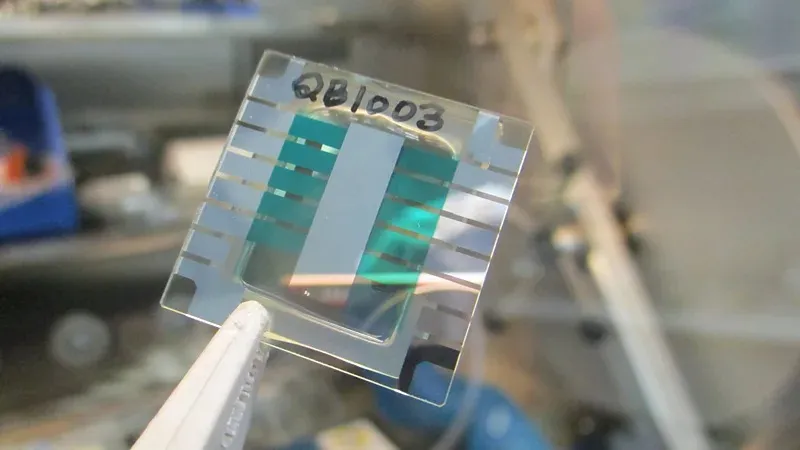
Scientists from the Australian National Science Agency (CSIRO) propose The first working prototype of a quantum battery has an unusual property: the larger the storage device, the faster it charges. With conventional batteries, the opposite is true: the greater the capacity, the longer it takes to charge. But the quantum world is so unusual that the collective interactions of particles inherent in it may be contrary to our everyday experience.
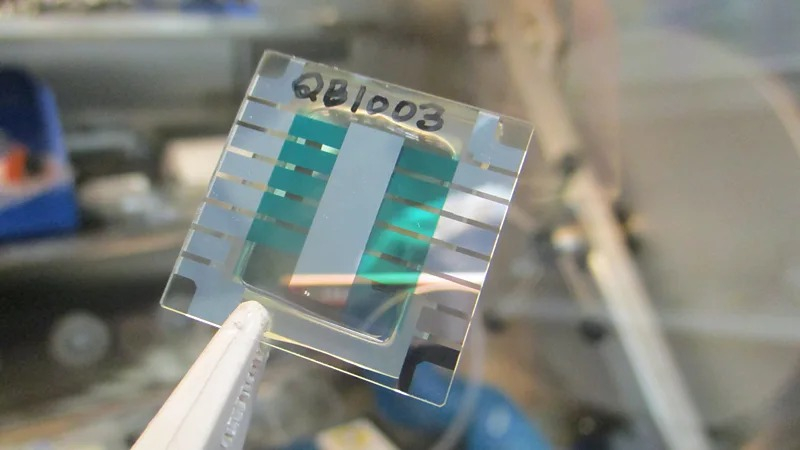
Image source: CSIRO
The proof-of-concept of the quantum battery was first reported in March this year. CSIRO researchers showed this was possible, but at the time they were unable to demonstrate a useful function of the quantum battery – drawing current from it to power a load. Today, as reported by the BBC, developers have completed the prototype and added another working layer, which made it possible to demonstrate the actual full operation of this unusual battery. However, there are no details on the matter yet and the data collected will be compiled into a scientific article later.
The basis of the prototype is an optical microcavity – a structure of two mirrors located about 100 nm apart from each other. Inside it are organic dye molecules that have been illuminated by lasers. In this case, there is a strong connection between the photons of light and the molecules of matter: a mixed state of light and matter is formed, called a quasi-particle polariton. This also leads to a superabsorption effect, in which molecules stop individualizing (absorbing energy independently of each other) and start acting synergistically. The more molecules involved in the process, the higher the rate at which energy is accumulated. In other words, the greater the capacity of this battery, the faster it can be charged.
Experiments have shown that quantum batteries can be charged in femtoseconds and retain stored energy for nanoseconds, about a million times longer than the charging time. The prototype’s accumulated energy is only a few billion electron volts, so it’s still very, very far away from practical applications in smartphones or electric cars, and many people are still skeptical if it comes to that. By August, however, researchers were able to add additional layers to the battery that could draw electrical current from the quantum storage device, marking an important step from demonstrating the physics to a full-fledged device.
The main advantage of the proposed design is the ability to operate at room temperature. Other quantum battery options based on superconducting materials require deep cooling to below about -150°C or even higher, which limits their use. However, experts note that the main problem remains unresolved: it is necessary to learn how to efficiently extract accumulated quantum energy in a stable and controllable form.
The most likely first application of this technology will be to power quantum computing systems, where ultra-fast power transfer can reduce power consumption and increase the scalability of quantum processors. The possibility of replacing conventional batteries in mobile phones and electric cars remains a subject of debate – even free-thinking scientists don’t allow us to be confident about the emergence of such products. At least for the foreseeable future.
Skeptics argue that, in principle, circuits with optical resonators are difficult to implement as stable sources of controlled current collection, let alone their use in household devices or electric vehicles. Superconducting options are easier to implement, but are unlikely to be developed for use with powerful consumers, and are definitely not suitable for powering household devices. But for powering quantum platforms, superconducting quantum batteries look like a viable solution, although it’s still in the early stages of development. But should we judge this so harshly? The world first learned about quantum batteries more than a decade ago, in 2013, but it’s unlikely that it had time to understand the discovery.
If you find an error, select it with your mouse and press CTRL+ENTER.