

The financial excitement surrounding the boom in artificial intelligence systems has forced Nvidia management to deviate from its rule of predicting, at best, the next quarter. Looking forward to the next fiscal year, Nvidia expects revenue to grow 70% to $673 billion, becoming the second-largest technology company in the United States by revenue, second only to Amazon (AWS).
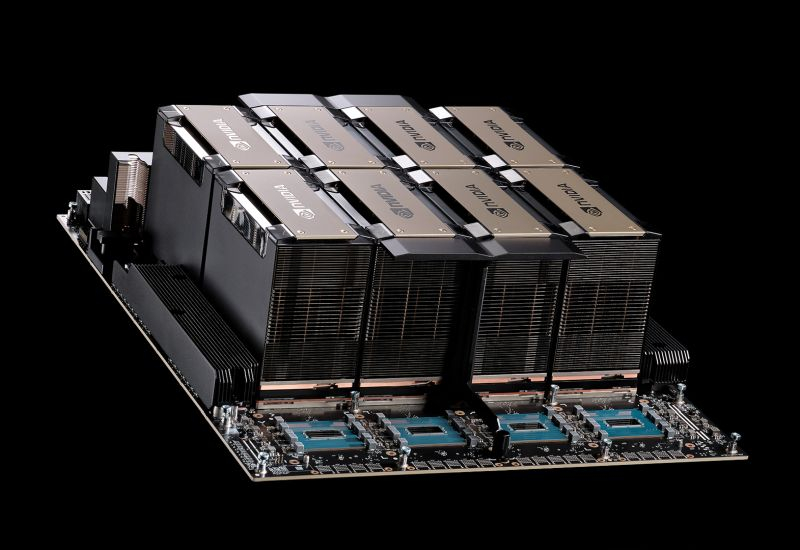
Image source: NVIDIA
Meanwhile, Apple and Alphabet (Google) will be left behind, as explained CNBC. It must be said that analysts surveyed by London Stock Exchange Group also predicted revenue growth for Nvidia’s next fiscal year, which begins in February 2027, but the increase was limited to a much more modest 44%, so Nvidia’s own forecast can be said to be significantly more optimistic. In essence, the company’s management is sending a signal to investors that its financial performance will continue to perform well next year, trying to allay growing concerns that the artificial intelligence boom is running out.
Nvidia Managing Director and Founder Jensen Huang admitted during the quarterly report that the above estimates were made taking into account that restrictions on increased parts production will hinder the company’s business development. He said the demand growth potential is much higher than Nvidia’s 70% revenue growth next year. “Our suppliers have given us 70% confidence and we will work with the supply chain to improve that number,” Huang pointed out. He explained the disclosure of his forecast for the next fiscal year, hoping to synchronize other market participants’ assessments of the near future: “Everyone has invested a lot in this game and we want to make sure everyone has the same information.”. The shortage of Nvidia components will last until at least the end of January 2028, according to the company’s management. Huang acknowledged that demand for the company’s products will at least double next year.
NVIDIA’s total revenue in the second quarter of this fiscal year increased by 106% year-on-year to US$96.2 billion, a quarterly increase of 18%, exceeding analyst expectations (US$92.2 billion). Margins improved to 75%, an improvement of 2.5 or 2.6 percentage points, depending on the calculation method. At the same time, it can’t be said that expenses haven’t increased – expenses in the operating area increased by 55% to $8.4 billion, but profits grew faster. Operating income increased by 124% year-on-year to US$63.7 billion, and net profit increased by 126% year-on-year to US$59.7 billion. It is worth noting that $7.8 billion of this amount comes from Nvidia’s investment income in the stocks of Intel, SpaceX and other public companies.
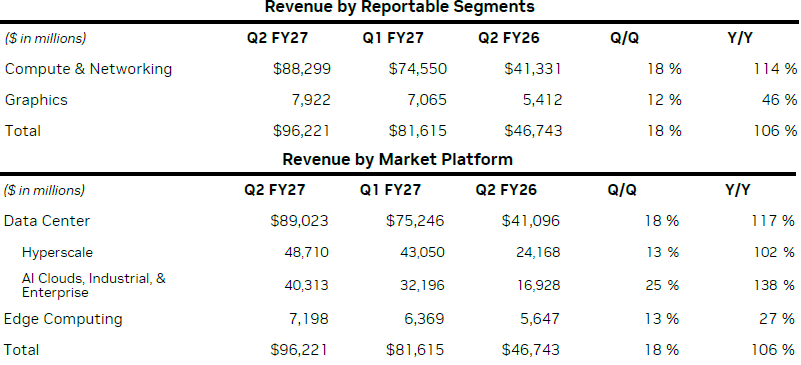
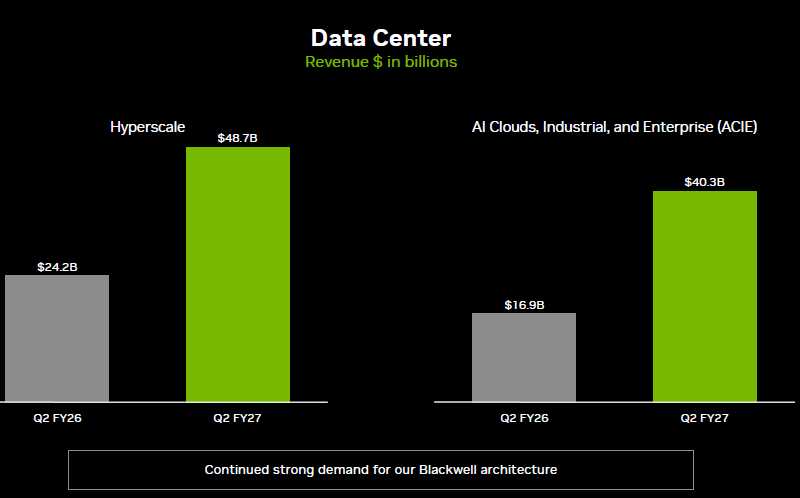
In the data center segment, revenue grew 117% to a record $89 billion, and Nvidia decided to build out its reporting in this area in more detail since last quarter. In addition, it also showed that the revenue in the hyperscale field increased by 107% compared with the previous year, reaching $48.7 billion. The second portion of server revenue comes from other cloud, industrial and enterprise customers purchasing data centers from Nvidia. In this case, we can talk about revenue growth of 138% to $40.3 billion. As Huang acknowledges, previously this group of customers, including the new wave of cloud service providers (neocloud), were almost invisible in the company’s revenue structure. NVIDIA recently initiated the creation of a fund to finance new projects in the field of artificial intelligence, aiming to support new players in the field without a clear credit history to obtain funding on general terms. In return, Nvidia will receive some revenue from new players in cloud services.
Nvidia’s founder reinforced his confidence in humanity’s growing need for computing power in a statement about the need for AI agents, which require 15 to 100 times more computing resources than a person working on a PC. OpenAI plans to purchase large quantities of Nvidia products by 2030, and another company has reached an agreement with Amazon (AWS) to supply 2 million AI chips in the next two years. At the same time, as Huang explained, the customer can buy millions of CPUs from Nvidia. Nvidia’s report also pointed out that it has begun delivering accelerators using the Hopper architecture to China, although its sales revenue did not exceed 1% of the total revenue in the data center field. Regardless, we’re talking about tens or hundreds of millions of dollars.
Second-quarter revenue in the peripheral computing segment, which most recently includes gaming graphics cards, edged up 27% to $7.2 billion. Nvidia Chief Financial Officer Colette Kress explained that in the consumer segment, demand fell in the second quarter due to higher prices, but workstations based on the Blackwell series of solutions, which are very popular, provided positive revenue dynamics. Colette Kress said memory price growth last quarter exceeded company management expectations, but price dynamics next year may be even more dramatic.
In addition, it is worth noting that the financial resources used to ensure product supply in the future period increased significantly in the second quarter: from 119 US dollars to 279 billion US dollars. Nvidia’s chief financial officer pointed out that these funds are mainly used to purchase memory chips. Taking into account the company’s guarantees for the implementation of various data center construction projects, this amount totals $366 billion. According to Nvidia management estimates, the cloud giant’s capital expenditures will grow from US$800 billion to US$1.3 trillion next year.
Nvidia expects revenue to hit $108 billion this quarter, the first time the company has topped $100 billion in three months. This forecast does not include shipments of computing accelerators to the Chinese market, and total revenue exceeded analysts’ expectations ($104.2 billion). Margins are about 74%, and operating expenses will equal $9 billion or $9.2 billion, depending on how it’s calculated. The Vera Rubin accelerator will account for about 20% of Nvidia’s data center revenue this quarter. At the turn of the fourth quarter and first quarter, the hyperscale business will begin to show higher revenue growth rates as Vera Rubin shipments gain momentum. As Kress highlighted, margins are likely to fall to 71-72% in the fourth quarter of this fiscal year, primarily due to high memory costs.
Last quarter, Nvidia returned $26 billion to investors, including $20 billion for stock repurchases and $6 billion for dividend payments. The company is preparing to return at least half of its free cash flow to investors, but as of the end of last quarter, that number actually hit 60%.
If you find an error, select it with your mouse and press CTRL+ENTER.