

Conventional glass-coated silicon solar panels can be described simply by a slogan from a popular German advertisement: “Quadratisch. Praktisch. Gut.” The flexibility and ease of roll-to-roll production is associated with promising perovskites. Italian scientists proved the opposite—they propose The process of manufacturing flexible silicon panels using calendering and plastic lamination has many advantages.
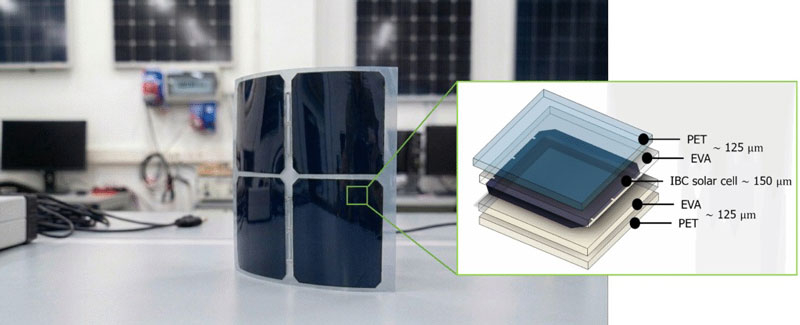
Image source: University of Padua
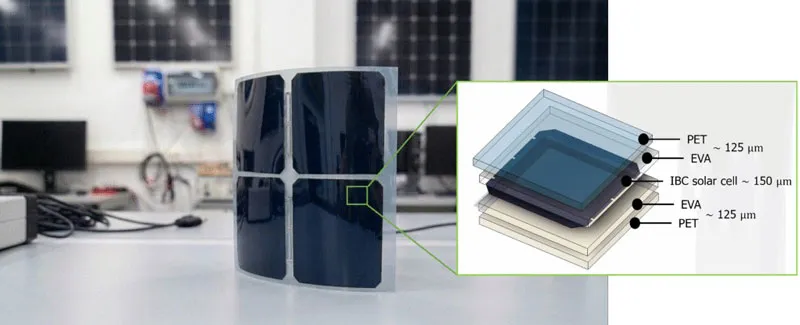
Scientists from the University of Padua and the Institute of Electronic and Magnetic Materials (IMEM-CNR) of the Italian National Research Council reported this development. They created an architecture in which fragile silicon solar cells are protected by polymer layers instead of heavy glass. The design is based on commercial silicon components and has an IBC (Interdigital Back Contact) back contact approximately 150 microns thick. Production has adopted continuous roll lamination technology, which may reduce the cost of manufacturing flexible solar panels.
The key design feature is the combination of proven silicon technology and mechanical flexibility. Typically, silicon solar cells require rigid glass shields and substrates because thin wafers are easily damaged by bending, vibration and thermal expansion. Italian scientists replaced the glass with polyethylene terephthalate (PET), which simultaneously acts as a protective layer and reduces the weight of the module. The prototype was fabricated using a SunPower Maxeon Gen III IBC manufacturing cell and assembled using hot roller lamination. The basic process mode is that the sealing temperature is about 390°C, the roller is heated to 130°C, the rolling speed is 9mm/s, and the roller gap is 2mm.
Tests show that the efficiency loss after lamination is approximately 4.4% relative to the original value, and the main reason is not damage to the silicon, but optical loss due to light reflection at the air/PET interface (which will be eliminated in the future by anti-reflective additives). The researchers conducted comprehensive tests on the plastic module, focusing on its operation in a semi-bent state. As a result, the single-element module can withstand bends up to a radius of 95.4 mm without forming new cracks, while the four-element module in the 2×2 format retains approximately 93% of its original capacity at a bend radius of 155 mm.
To test the long-term performance of the components on curved surfaces, the 2×2 prototype was mounted on a curved base with a bend radius of 150 mm and spent 672 hours (28 days) outdoors. Thereafter, it retained 96.12% of the original efficiency, indicating that the solution had no major design flaws. Analysis of the damaged components showed that the lamination process did not create new cracks, although it could lead to the propagation of existing defects.
Going forward, the team plans to reduce reflection losses, replace traditional wire soldering with a soldering paste soldering technique more suitable for coil production (which will allow connections to be melted at the contact points and re-soldered without mechanical stress), and conduct long-term testing through repeated bending and thermal expansion cycles. The technology is seen as promising for integrated solar power in buildings, transportation and other applications where traditional glass panels are too heavy or unsuitable due to a lack of flexibility.
If you find an error, select it with your mouse and press CTRL+ENTER.