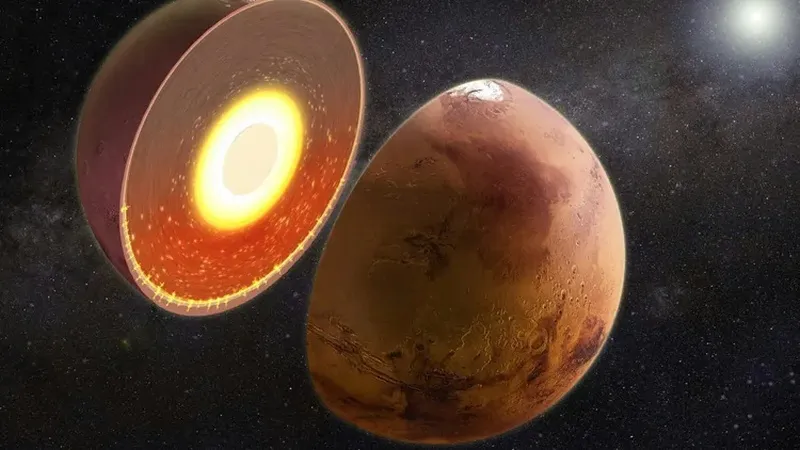
New research into the interior of Mars once again shows that the Red Planet is a world made up of two completely different halves. Temperatures deep in Mars’ southern hemisphere are 400°C warmer than beneath the northern hemisphere, exacerbating tensions between Mars’ flat north and rocky southern highlands. Scientists say this could help shed light on Mars’ possible past habitability and the duration of its volcanic activity.
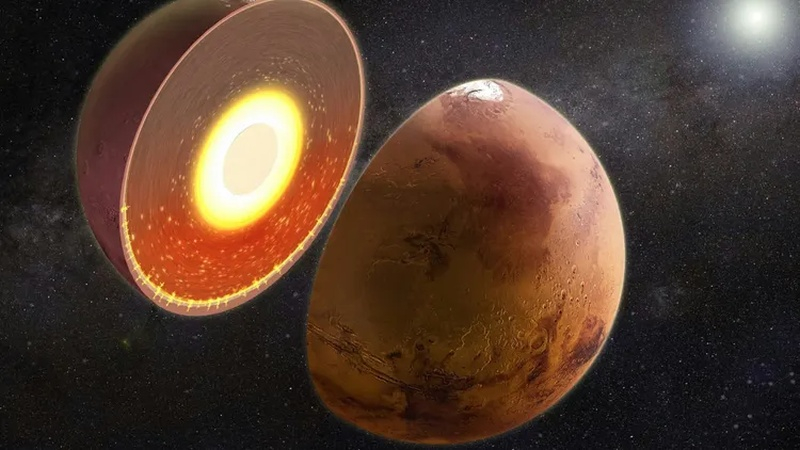
Image source: NASA
Astronomer Alexander Byrne and his team examined historical data from three NASA spacecraft – the Mars Global Surveyor, Mars Odyssey and the Mars Reconnaissance Orbiter – to identify subtle changes in their orbital speeds that could reflect changes in Mars’ gravitational field.
The gravitational field changes experienced by the spacecraft are very different from what would be expected if the internal structure of Mars were completely spherically symmetrical. To explain this difference, the mantle temperatures beneath Mars’ southern hemisphere must be 200 to 400 °C warmer than those in the northern hemisphere.
Using Byrne’s “tidal tomography” technology, scientists were able to build a model of Mars’ internal structure and temperature, which also takes into account changes in the Sun’s gravitational influence on Mars as it moves in an elliptical orbit. “Scientists often think that the internal structure of planetary bodies is generally spherically symmetrical, but this is not necessarily the case.”Byrne pointed out.
The interior structure of the southern part of Mars is significantly different from that of the northern part, and the planet’s surface is also asymmetrical. The northern part of Mars is characterized by lowlands, while the crust in the south is on average 25 kilometers thicker than in the north and is covered with cratered highlands. The northern lowlands may have once been the bottom of the ocean. “The north-south difference we observed is important because it provides information about processes that may affect Martian hydrology, including the formation of pools of water that may contain water.”“, the scientists explained.
A hotter southern mantle could also explain some other puzzling discoveries on Mars. NASA’s InSight lander, which ends its mission in December 2022, found that seismic waves dissipated more quickly in the south, which could be explained by higher temperatures in the region.
A global magnetic field does not exist on Mars today, but it did exist more than four billion years ago. If updrafts from the warmer southern mantle heat the crust beyond the “Curie temperature,” the temperature at which the material loses its inherent magnetism and induces a remanence, this could lead to the formation of mysterious magnetic residues in iron-containing minerals.
Scientists believe that this is all the result of an ancient giant collision that occurred more than four billion years ago, and that the northern lowland is actually a huge impact crater. This collision released a large amount of internal heat, causing the northern mantle to cool faster than the southern mantle. Another theory is that the thicker crust in the south may have effectively prevented much of the heat from escaping from the mantle.
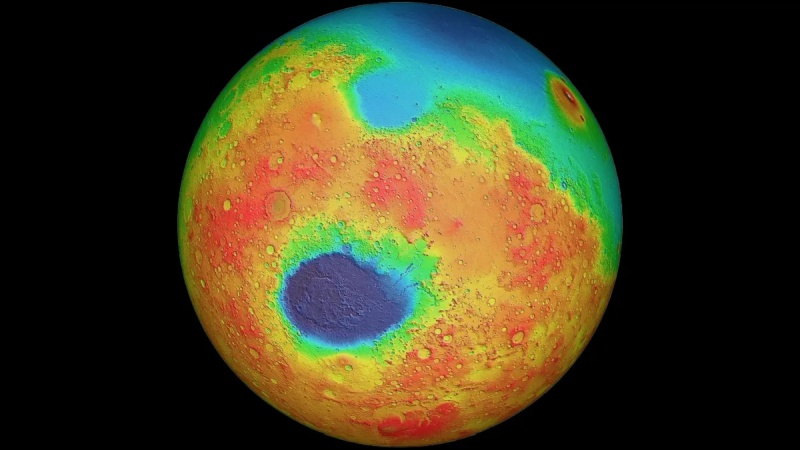
The resulting false-color heat map of the Martian surface shows the Hellenic Basin, a large dark blue area below the center that is one of the largest impact craters found on Mars and in the solar system. It is believed to have formed approximately 4 billion years ago. Image source: ESA/MOLA science team
Byrne said the tidal tomography method could also be used to study other planets in the solar system, from Mercury to Jupiter’s large moons.“As we obtain more gravity data, we can determine three-dimensional features of the planet’s internal structure,” ——convinced Bern. —These findings provide us with a blueprint for designing future missions and scientific exploration of these worlds. Understanding the internal structure of planetary bodies helps us uncover the processes that shaped their formation and evolution. “
If you find an error, select it with your mouse and press CTRL+ENTER.