

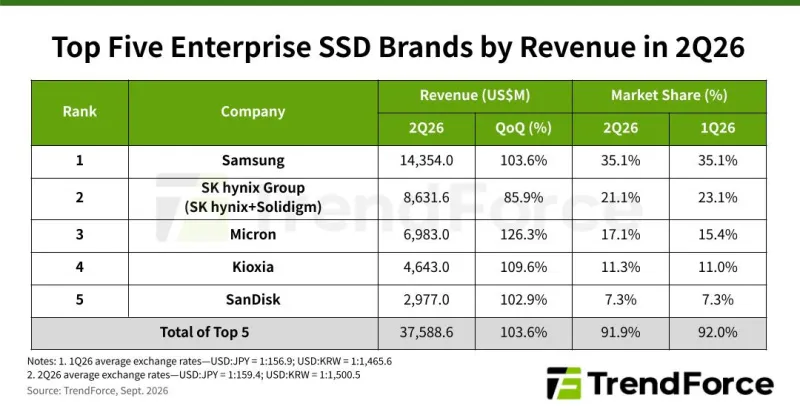
The global enterprise SSD market shows rapid growth: according to data According to TrendForce statistics, the total revenue of the top five manufacturers in the second quarter of 2026 reached US$37.59 billion, a quarterly increase of 103.6%. Such significant dynamics are due to rising prices against the backdrop of an ongoing shortage of NAND flash memory chips.
Samsung remains the largest industry player: The company roughly doubled its revenue in the quarter to $14.35 billion while maintaining its 35.1% share. Analysts talked about the high demand for Samsung’s 176-layer QLC products and the increasing share of high-performance products using the PCIe 5.0 interface.
Ranked second is SK Hynix, whose revenue this quarter increased 85.9% to US$8.63 billion. At the same time, the company’s share fell from 23.1% in the first quarter of 2026 to 21.1% in the second quarter. SK hynix continues to increase shipments of solutions based on 321-layer TLC memory.
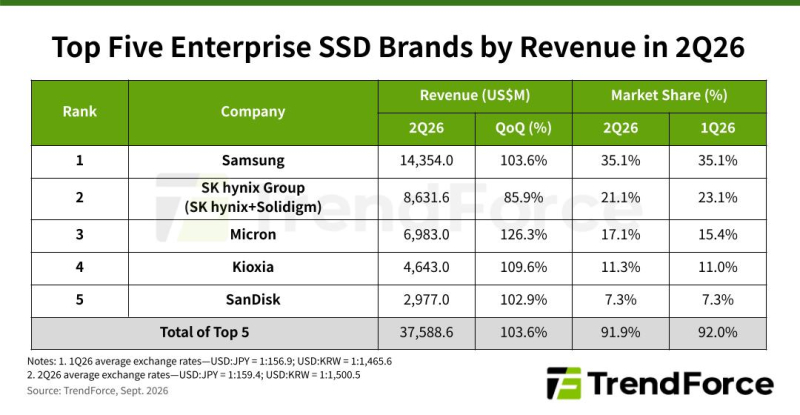
Among the top three is Micron Technology, which has the most significant growth among the top five manufacturers, with revenue falling 126.3% quarterly to approximately US$6.98 billion. The company’s market share increased from 15.4% to 17.1%. In addition to the substantial growth in shipments of high-performance SSDs based on 232-layer QLC memory, the company is also actively developing enterprise-class hard drives with PCIe 6.0 interface.
The top five also include Kioxia and SanDisk, with revenue of US$4.64 billion and US$2.98 billion respectively: these companies’ sales grew by 109.6% and 102.9% quarterly. Their market shares are 11.3% and 7.3% respectively.
TrendForce experts predict that the demand for enterprise-class SSDs will continue to be strong in the future. The key drivers of the market are the introduction of generative artificial intelligence services, expansion of data center infrastructure, and availability of powerful server platforms.
source: