


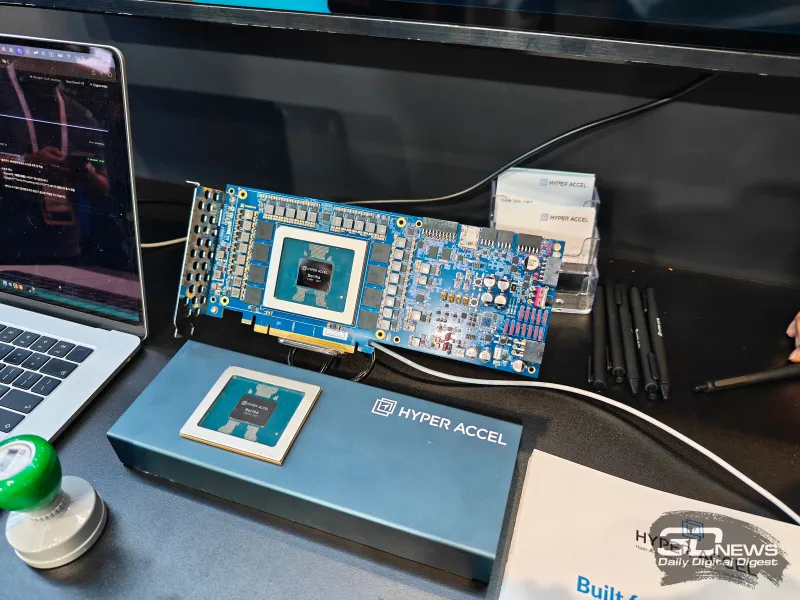
Korean startup HyperAccel demonstrates dedicated accelerator Berthadesigned to perform artificial intelligence reasoning. According to the developer, the main feature of the product is high economic efficiency.
Bertha’s solution uses LPDDR chips instead of expensive HBM memory. It uses a proprietary Streamlined Dataflow architecture to minimize data movement. Memory bandwidth is precisely matched to the accelerator’s computing power, allowing up to 90% of available hardware resources to be used during inference. thanks to this reached The token value per second is five times higher compared to traditional solutions with comparable TOPS values.
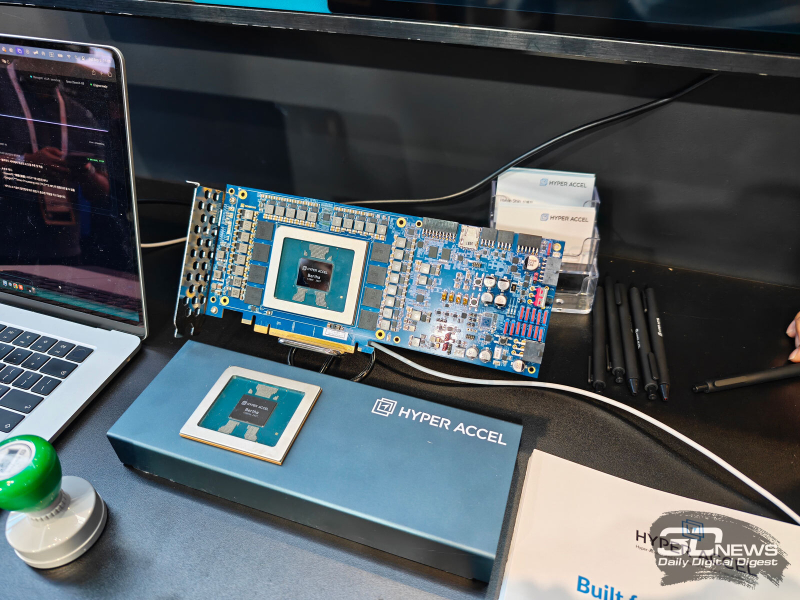
HyperAccel showcased the Bertha 500 accelerator, which is manufactured using Samsung’s 4nm technology. The device uses a dual-slot expansion card design, including 32 LPU cores, 4 Arm Cortex-A53 cores, 256 MB SRAM and 128 GB LPDDR5X (256 GB in the future), with a throughput of up to 546 GB/s. TDP is 250W. The new product delivers up to 768 Tflops of performance in FP8/INT8 mode and up to 384 Tflops of performance in FP16 operation. In addition, FP4, BF16, and INT4 formats are also supported. Mass production is planned to begin in early 2027.
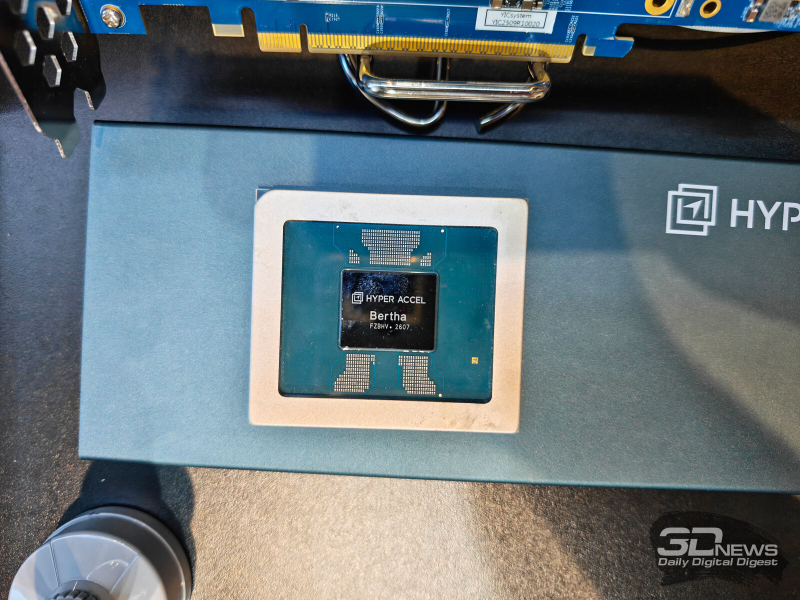
HyperAccel is also preparing the Bertha 100 accelerator for AI agents. This product has M.2 form factor. It is equipped with 16 GB LPDDR5X and has a throughput of 64 GB/s. The performance of FP8 operation is approximately 32 Tflops. Also supports BF16, FP4, INT8 and INT4 modes. Samples of the product will appear in the fourth quarter of this year.
The accelerator is compatible with frameworks such as PyTorch, ONNX, and vLLM. Developers can access a set of SDKs to further optimize, deploy and analyze solutions based on specific needs. HyperAccel claims Bertha is five times more energy efficient NVIDIA H100 And provide about 20 times the price/performance ratio. As of February 2026, HyperAccel had raised $45 million in funding and had approximately 80 employees.
source: