
Arm has launched a GPU that is expected to significantly improve the graphics quality of smartphones. The proposed solution is able to provide high-quality graphics output on mobile systems with limited energy consumption – for this purpose artificial intelligence algorithms will be used.

Image source: arm
Modern smartphones have very limited energy resources compared to PCs – only 1 or 2 W allocated to graphics, but even within these resources it is necessary to continuously improve the quality of the output images, using high-resolution textures, ray tracing techniques and paths. Arm, with its new graphics platform Mali G2 NX, has taken a radical approach to solving this problem, proposing to allocate only one-eighth of resources to native rendering and shift the remaining seven-eighths to image reconstruction algorithms using AI. It is recommended to offload three tasks in games to them: Neural Super Sampling (NSS), Neural Frame Rate Boost (NFRU), and Neural Super Sampling and Denoising (NSSD).
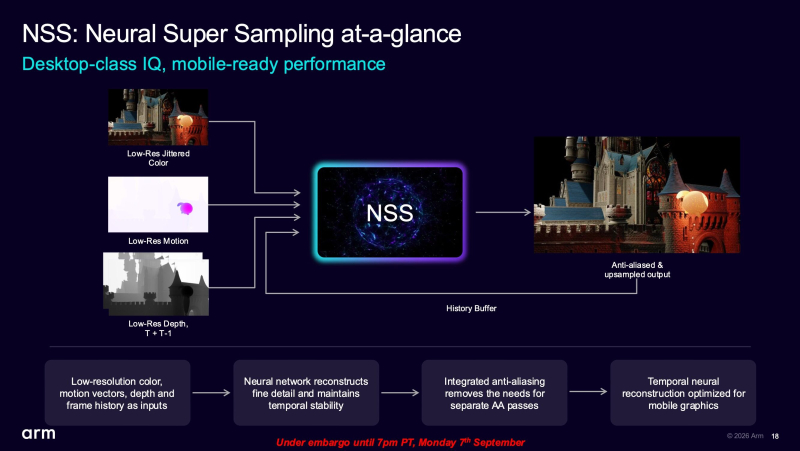
NSS technology involves rendering frames at a low resolution and using AI to scale them – for example, four times from 540p to 1080p. To reconstruct a high-resolution image, motion vectors, depth information, and images from the previous frame are used—this helps with issues such as temporal stability and anti-aliasing. The result is that the DRAM bandwidth and power consumption required per frame is halved.
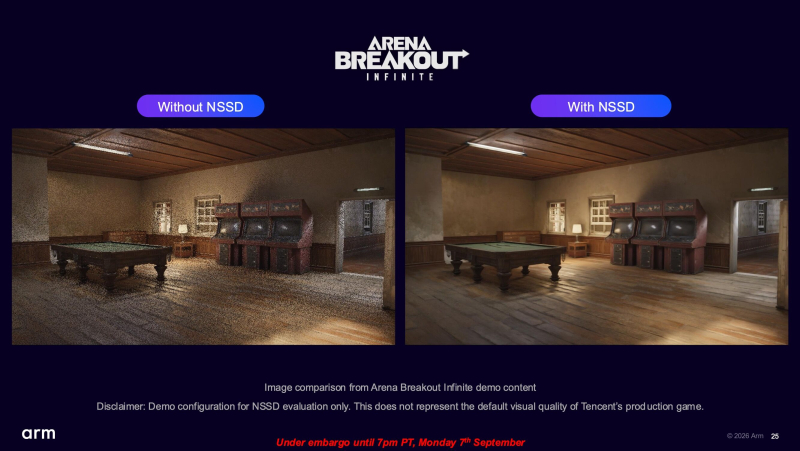
NSSD technology aims to use AI to provide instant ray tracing, reducing the number of rays per pixel on mobile devices.
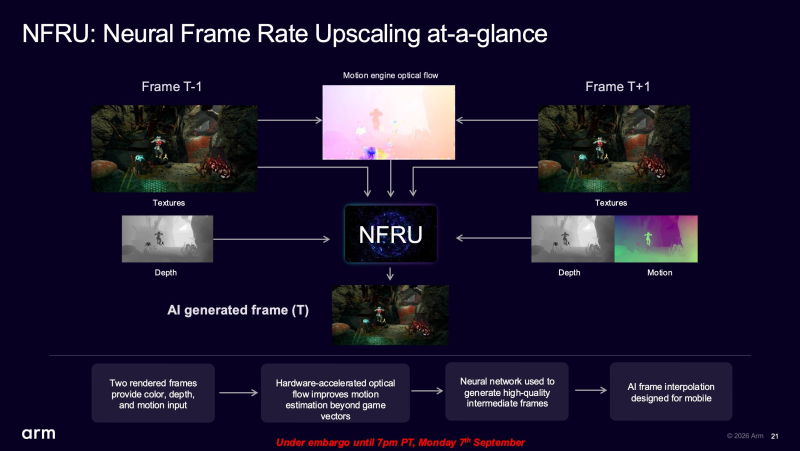
NFRU involves generating a new frame based on data from two adjacent frames. The algorithm analyzes two actually rendered frames (previous and next) along with their color, depth, and motion information, and generates an in-between frame. The graphics processor incorporates a neural accelerator that can calculate the mechanics of motion and determine the actual movement of an object between two images. This technology is similar to the frame generators included in Nvidia DLSS and AMD FSR.
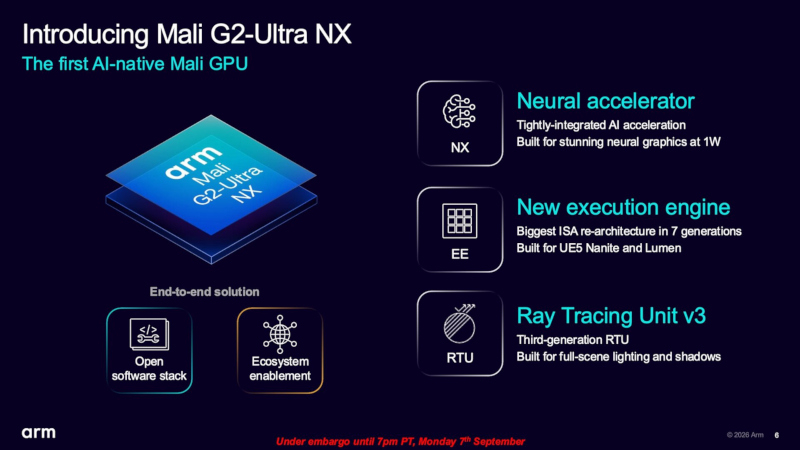
Graphics Arm Mali G2 NX is implemented in three variants:
- Mali G2-Ultra NX – 10 or more shader cores, 6 or more neural accelerators, ray tracing unit in each shader core;
- Mali G2-Premium (NX) – 6 to 9 shader cores; ability to integrate neural accelerators, but only on shader cores; ability to install ray tracing blocks;
- Mali G2-Pro (NX) – 1 to 5 shader cores; ability to integrate neural accelerators, but only on shader cores; ability to install ray tracing blocks.
Other innovations include a third-generation ray tracing unit, which involves the joint calculation of common edges in triangles, which allows you to use more useful information in the cache and reduce the amount of data transferred to DRAM – in testing, the load on DRAM was reduced by up to 13%. Implemented hardware support for Hardware Opacity Micromapping (OMM) – a technology that helps more efficiently trace light on transparent or partially transparent geometric objects. These solutions will help mobile systems achieve the same quality as desktop computers.
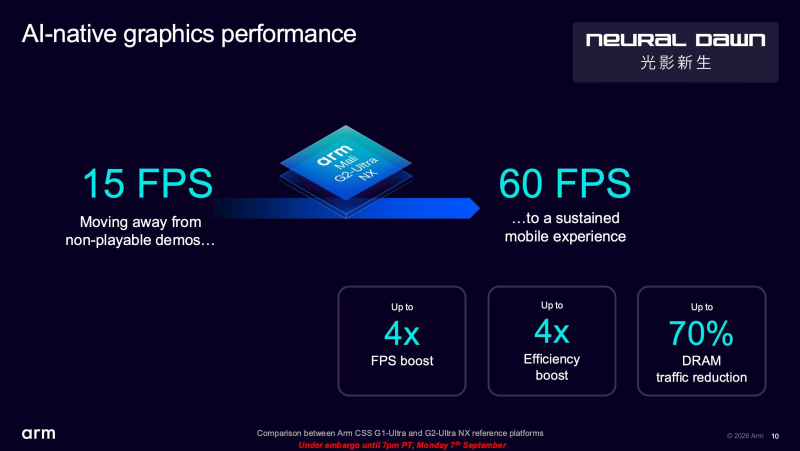
As a result, Arm says the Mali G2-Ultra NX can increase performance from 15 to 60 frames per second while reducing DRAM consumption by up to 70%. The updated ray tracing execution unit showed a 24% performance increase in testing; even with the AI function turned off, the performance increased by 14%; and when rendering the same scene, the load on the graphics subsystem can be reduced by up to 70%. Arm said it will take a year and a half for game developers to integrate the new solution. Arm Mali G2-Ultra NX, Mali G2-Premium NX and Mali G2-Pro NX graphics chips will debut in the coming weeks.
If you find an error, select it with your mouse and press CTRL+ENTER.