

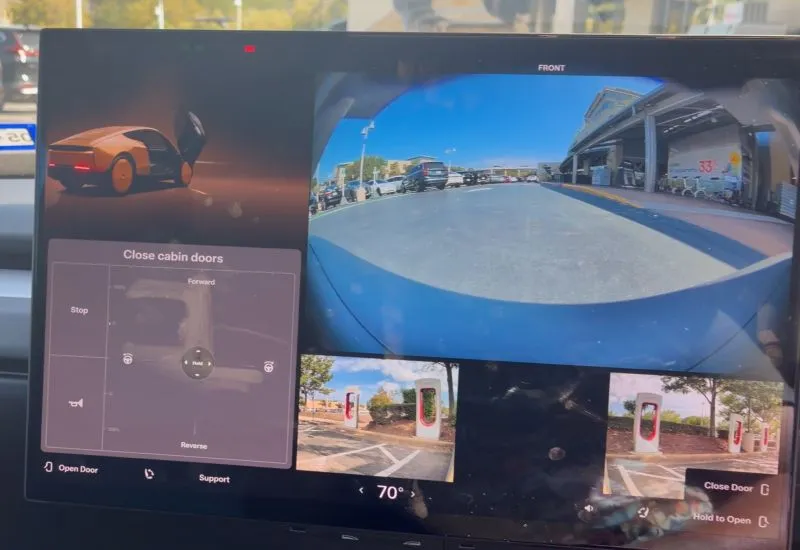
The launch of the Tesla Cybercab self-driving taxi service in the Texas capital naturally opened the doors of their salons to regular customers, who began sharing their travel impressions on their social media pages. An eyewitness accidentally discovered how to control the car manually without a steering wheel and pedals: these functions are assigned to the touch screen in the center console.
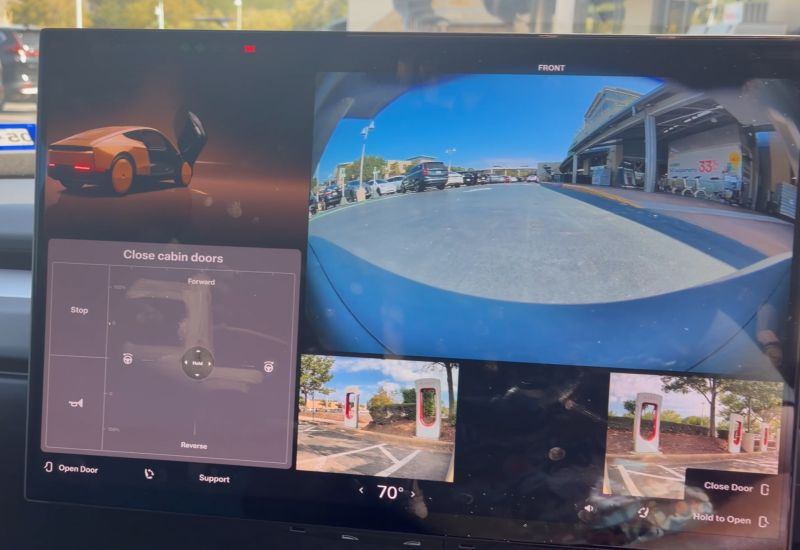
Matthew Skrzypczak, one of the customers served by the brand, shared his experience of ordering a Tesla Cybercab robot taxi on the page of the social network X. When he entered the cab, he discovered an interface for manual control of the car on the central display, which combined images from omnidirectional cameras with virtual buttons, allowing him to set the position and direction of movement of the front wheels, stop the car and use audio signals.
As the author of the publication rightly suggests, the car was probably switched into special mode by a Tesla employee who charged it at a proprietary charging station shortly before going to take a customer call and was able to operate it using this interface menu. Additionally, the display shows footage from the same charging station. In normal mode, passengers can only use functions such as controlling door actuation and calling technical support. Passengers can also adjust the microclimate in the cabin and adjust the position of their seats.
Incidentally, NHTSA, the US agency responsible for US road safety, has questioned Tesla about the legality of allowing the Cybercab without a steering wheel, pedals and rearview mirrors to drive on public roads. During the testing phase, Cybercab prototypes were equipped with steering wheels and pedals, with testers inside, and one had a wired joystick from a gaming console for easy maneuvering around the booth.
If you find an error, select it with your mouse and press CTRL+ENTER.