

OpenAI said its artificial intelligence has solved one of the famous seven millennium problems – the existence and smoothness of solutions to the Navier-Stokes equations, a problem that mathematicians have been grappling with for decades. These equations describe the motion of liquids and gases, but so far no one has been able to show whether their smooth solutions always remain so indefinitely, or whether under certain conditions the flow rate can increase indefinitely in a finite time.
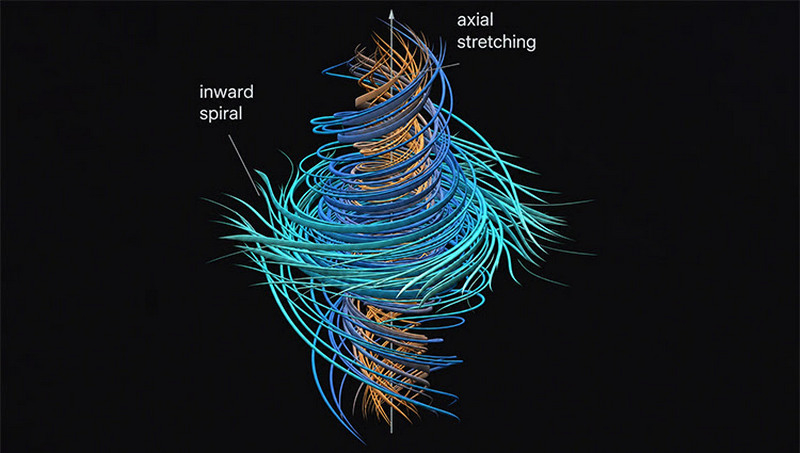
Image source: OpenAI
These equations are named after Claude Louis Navier and George Gabriel Stokes, both of whom worked in the 19th century. In 1934, Jean Leray proved the existence of generalized solutions, but the question of whether solutions to three-dimensional problems remained smooth remained open for about 90 years. In 2000, the Clay Mathematics Institute included the problem in its list of seven Millennium Challenges. There is a $1 million reward for solving each problem.
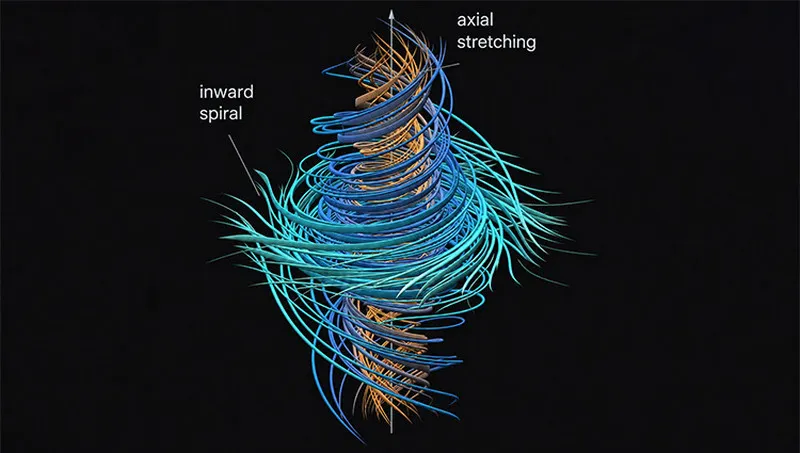
OpenAI AI constructed an example of the second solution of the equation: an initially stationary fluid forms a gradually shrinking vortex under the influence of a smoothly changing external force, and its speed increases without limit in a limited time. In this case, the total energy of the liquid is still limited. The vortex simultaneously twists inward and stretches along its axis, gradually shrinking its central area.
The technical difficulty lies in obtaining this smoothness destruction due to the dynamics of the fluid itself, rather than simply setting an infinite external force. In the solution found, acceleration, pressure gradient, momentum transfer and viscosity become very large but at the same time exactly compensate each other so that the external forces remain smooth even when the fluid velocity goes to infinity.
The computational scale is impressive. A system of approximately 10,000 AI agents based on an as-yet-unreleased OpenAI model with capabilities higher than GPT-6 Astra performs the task simultaneously. In 88 hours, the agents exchanged 2.7 million messages and found a solution, after which GPT-6 Astra spent an additional 17 hours formalizing and verifying the proof in a lean mathematical system. When solving the Navier-Stokes problem, the agent used approximately 130 billion output tokens. Mark Chen, head of research at OpenAI, said the computing resources cost the company millions of dollars.
At the same time, the path to solving the problem also starts with another problem. Nearly 100 OpenAI agents spent about 50 hours studying the regularity problem of Euler’s equation – a simple version of the Navier-Stokes equation that does not take into account viscosity. The system unexpectedly receives evidence of a singularity occurring in an unforced (i.e., no external force) version of the problem. Afterwards, OpenAI redirects the resources to Navier-Stokes and uses the resulting Euler results as a starting point.
This is where an important mathematical caveat comes in. Results OpenAI uses external terms or forces in the Navier-Stokes equations. The term appears in the official formulation of the Clay Institute problem, but many mathematicians usually consider the unforced version, arguing that forcing is not important for problems arising from singularities. Mathematicians have previously suggested that it is this often-overlooked term that could lead to a breakdown in smoothness. Therefore, some experts may view OpenAI’s results as exploiting a vulnerability to solve a problem, rather than a solution to the problem as it is commonly expressed.
But interestingly, the discovery immediately turned into a scandal. New York University mathematician Tristan Buckmaster and Anthropic collaborator Levent Alpöge previously obtained important results on the above-mentioned Euler equation, which was seen as a step toward solving the Navier-Stokes problem. Mathematicians have also come up with the idea of using external force terms in Euler’s equations. They used Codex in their work, and OpenAI launched its own attack on the Millennium Challenge after rumors emerged about possible solutions to two of the challenges. Therefore, Buckmaster suspects that unpublished work from their Codex conference may have affected the OpenAI model in some way.
OpenAI denies this and claims that its employees and AI agents did not see the researchers’ material and independently arrived at the results. The company claimed that on September 1 it had heard only rumors about possible solutions to the two Millennium Challenges, and then launched a massive review of all outstanding issues. However, the company cannot rule out the impact of anonymous data obtained when using its products. As a result, the story has also turned into a debate about whether it is safe to trust unpublished scientific findings of artificial intelligence.
After completing its own proof, OpenAI contacted the researchers, believing they had also solved the Navier-Stokes problem, but discovered they were talking about different results. Buckmaster himself claimed that when speaking with OpenAI representatives, the company offered a publishing option where he would be the sole author of the Navier-Stokes paper and Alpöge’s name would not be mentioned. OpenAI denies its proposal to exclude Alpöge as an author.
One final point must be made by mathematicians: published proofs must be independently verified. Furthermore, questions that need to be addressed are whether the discovered constructs fit the original formulation of the Clay Institute problem and whether the use of forcing can be considered a mature solution to the problem. OpenAI said beforehand that it would not claim the $1 million bounty offered to solve the problem.
If you find an error, select it with your mouse and press CTRL+ENTER.