



If previously representatives of the Korean semiconductor industry estimated the delay of Chinese counterparts at about five years, now in the most complex area – HBM memory – the gap has narrowed to three years, while in other areas the gap is usually one to two years.
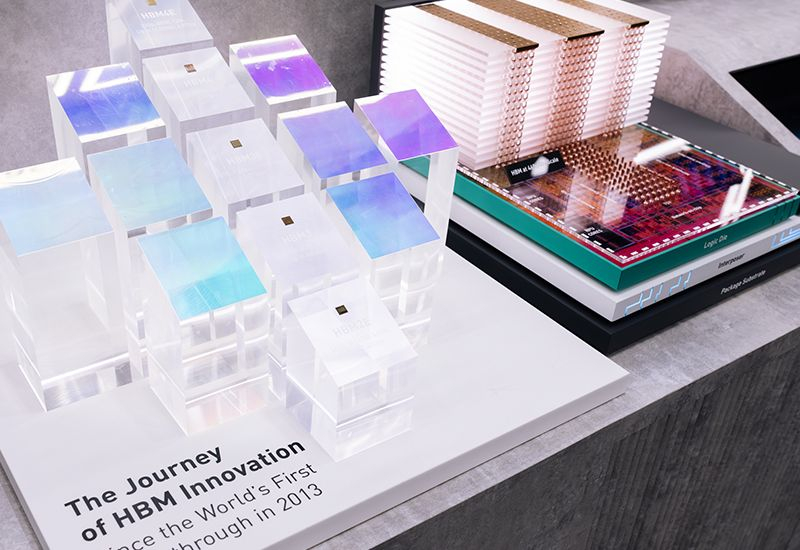
Image source: SK hynix
It is rumored that Changxin Storage is already testing the fifth generation HBM, HBM3E, and is expected to start mass production next year. HBM3E is only one generation younger than HBM4. South Korea’s Samsung, SK Hynix and the United States’ Micron Technology have begun mass production of this memory. Meanwhile, Changxin Storage is believed to be mass-producing HBM3, as it claims Korea JoongAng Ilbo Refer to representatives of the Korean semiconductor industry.
South Korean experts said that China’s semiconductor industry is making rapid progress, and it took only one year to achieve what foreign competitors took three years to achieve. China’s huge domestic market, developed R&D system, and government support ultimately allow us to move forward at this speed. Without access to advanced EUV scanners to produce wafers with finer lithography standards, Chinese companies are focusing on improving memory packaging technology and integrating different components.
According to DigiTimes, China Changxin Storage used the X-Stacking technology that Yangtze Storage used when releasing 3D NAND to produce HBM memory. The technique of splicing two silicon wafers reduces the distance electrical signals must travel, increasing memory bandwidth and reducing power consumption without the need to switch to EUV devices. Huawei Technologies is moving in a similar direction, proposing to “fold the wafer in half” and connect the two halves together through vertical information transmission channels.
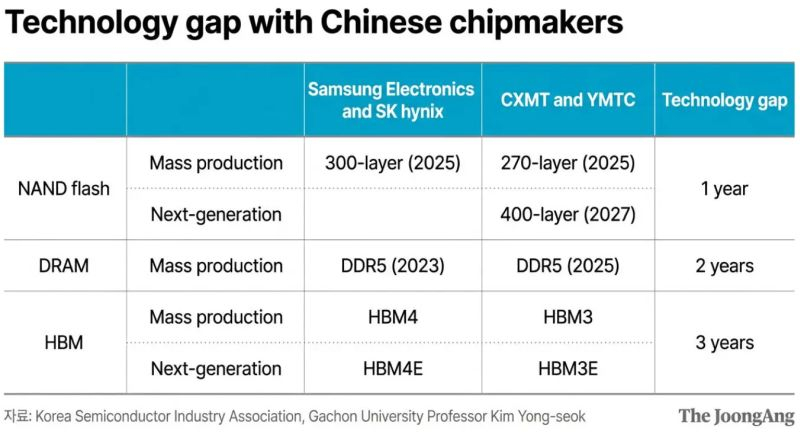
Image source: Korea JoongAng Daily
Chinese companies started producing DDR5 memory only two years later than Korean companies. In the field of 3D NAND production, Yangtze Memory reached 270 layers last year, while its Korean competitors reached 300 layers. Next year it can already surpass them by providing 400 layers of memory. Changxin Storage’s DRAM sales revenue ranks fourth in the world with a 10% share, and its operating profit margin (82%) exceeds that of its Korean competitors. Yangtze Storage accounts for 14% of the global NAND market and will become the global market leader by the end of next year. Through its listing, Changxin Storage has raised nearly US$10 billion, which it plans to use to expand production capacity. At the same time, according to available information from the same Korean publication, it cannot be said that the company is performing well in the production of advanced products, as its yield rate for available HBM3E wafers does not exceed 25%. This is a rather low result compared with the 80% generally accepted by the industry and reflects the high defect rate, high production costs and limited output of Chinese companies’ assembly lines.
If you find an error, select it with your mouse and press CTRL+ENTER.