

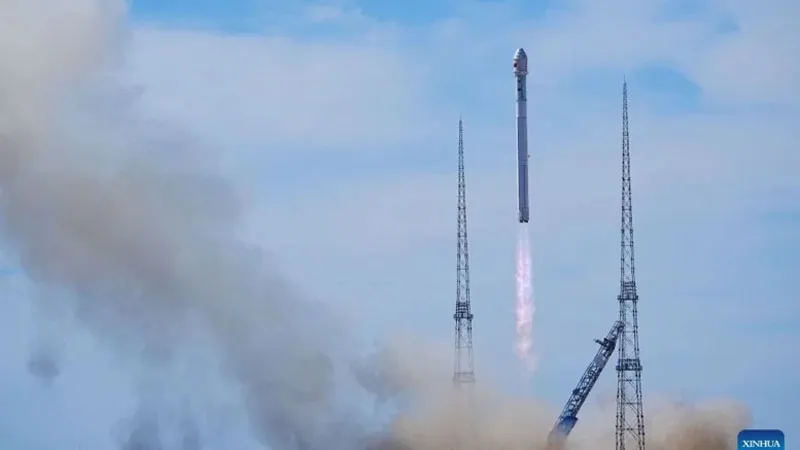
September 15 China spend The launch of the Suzaku-2 Y-7 rocket, an improved version of private company Blue Arrow Aerospace’s two-stage launch vehicle. The launch took place at 14:26 Beijing time (09:26 Moscow time) at the Jiuquan Space Launch Site. The rocket successfully launched 10 “Foresail” satellites of the network constellation into designated orbits. This is the first package launch of a Chinese satellite constellation by a private rocket, which was previously done by the state.
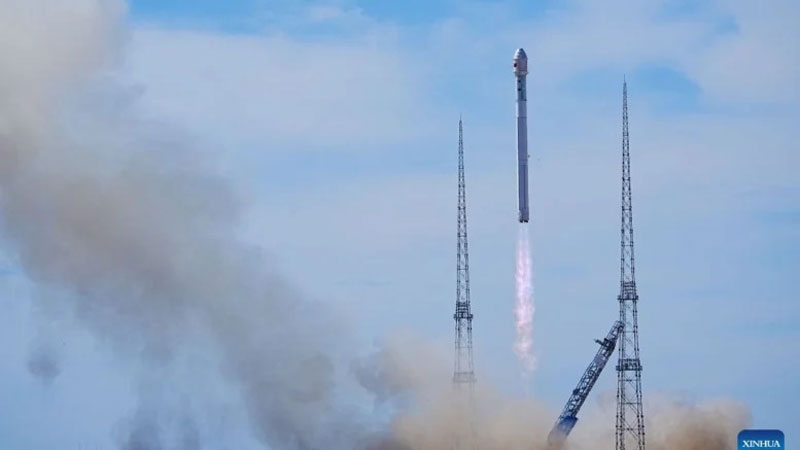
Image source: Xinhua News Agency
The Block 2 version of the Suzaku-2E missile is a significantly modified version of the original Suzaku-2. The height of the rocket is about 55.9 m, and the launch mass is about 267 tons. Both stages use a fuel pair that is more environmentally friendly than kerosene – liquid methane and liquid oxygen. The first stage is equipped with four TQ-12A engines with a total thrust of approximately 3312 kN, and the second stage is equipped with a TQ-15A engine with a controlled nozzle. The declared payload capacity reaches 6 tons in low-Earth orbit and 4 tons in sun-synchronous orbit with an altitude of about 500 kilometers.
In modern versions of the rocket, the supply of fuel assemblies has been increased, allowing the replenishment of liquid oxygen and methane in a supercooled state. This increases their density and allows you to hold more fuel without increasing the tank size. The design also uses a common bulkhead between the fuel tanks, which reduces the rocket’s dry weight. The second stage is capable of performing up to three engine burns: a main one – to enter orbit, a correction one and a final one – to take the stage itself out of orbit after satellite separation. The latter feature is also designed to reduce the amount of large space debris.
The ten devices launched on September 15 are part of the SpaceSail constellation, which is being created as China’s broadband satellite network system. This launch is already the 15th batch of satellites for the network. In 2023, the Suzaku 2 rocket became the world’s first methane rocket to successfully enter orbit, and the current Block 2 modification is designed to transition from demonstration flights to regular high-volume satellite launches. Today, the SpaceSail constellation includes 248 satellites, 22 of which are considered inactive and awaiting information from orbit.
Most of the satellites are launched into space by the China Aerospace Science and Technology Corporation’s (CASC) Long March series of rockets. Involving many private companies in the deployment process will help China quickly catch up with Elon Musk’s Starlink constellation, which currently has 11,000 active satellites. Chinese-made reusable rockets will also help, with the developers of the Suzaku-2 rocket also having success, but that’s another story.
If you find an error, select it with your mouse and press CTRL+ENTER.