

AMD Published (PDF) First detailed test results of the Epyc Venice server processor. In the SPECrate 2026_int_base test, the flagship 256-core Epyc 9996 is 78% faster than the 192-core Epyc 9965 with Zen 5c architecture. This cannot be explained by a simple increase in the number of cores: in terms of one core, Zen 6c’s advantage reaches about 34%. However, this is not a pure IPC increase, as the compared systems differ not only in the processor.
Image source: AMD
In addition, AMD said that in the same test, the overall performance of the Epyc 9996 was more than twice that of the Intel Xeon 6980P and Nvidia Vera. The 96-core Venice configuration is about 20% faster per core than the 88-core Nvidia Vera processor. When evaluating the results presented, it should be considered that AMD used different system configurations and obtained some of its competitor metrics from third-party sources. Some comparisons used different versions of the GCC (GNU Compiler Collection) compiler, which may also affect the results. In addition, the numbers given by AMD should be regarded as preliminary estimates until the SPEC results are officially announced.
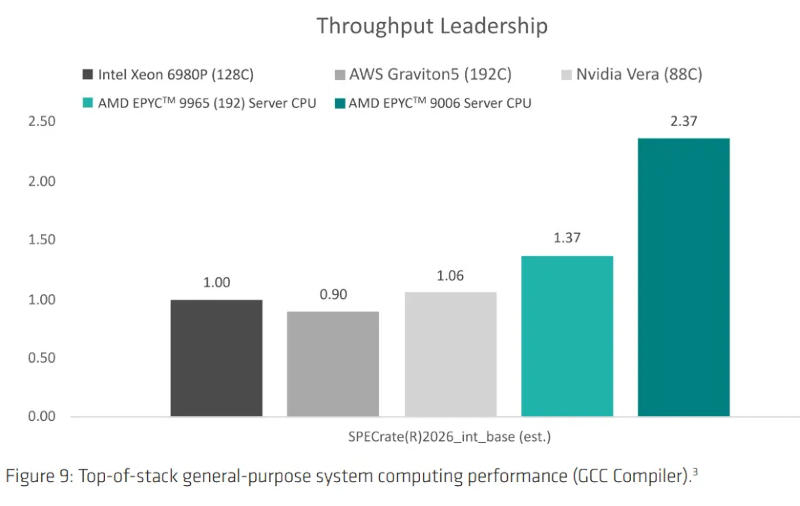
First, AMD showed results from SPECrate 2026_int_base, a test of overall system throughput when performing integer tasks. These metrics were obtained in July using GCC 15.2. The test involves launching multiple copies of the application simultaneously on the same processor; typically their number corresponds to the number of hardware threads, although AMD does not specify this individually.
According to the company, the 256-core Epyc 9996, which was anonymously designated as a 256-core Epyc 9006 series processor in previous materials, turned out to be 2.37 times faster than the Intel Xeon 6980P and 2.24 times faster than the Nvidia Vera. The new product is about 78% ahead of the previous generation 192-core Epyc 9965.
This comparison provides a rough estimate of the progress of the Zen 6c architecture relative to Zen 5c. Compared to Epyc 9965, Epyc 9996 has a 33% increase in core count, while the overall result is about a 78% increase. On a rough per-core basis, Venice’s advantage is about 34%. However, this value cannot be considered a pure increase in IPC: processors vary in frequency, energy constraints, and memory subsystems, while SPECrate measures the throughput of the entire server platform. The results still show that this growth is guaranteed not only by an increase in the number of cores, but also by an increase in the performance of each core.
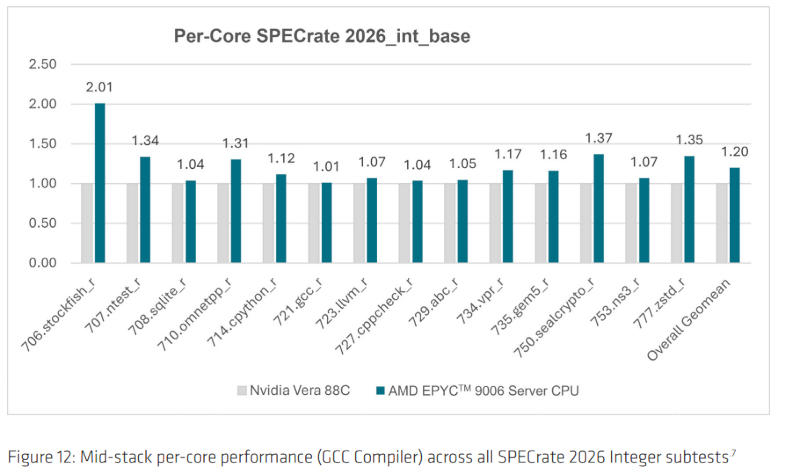
A significant part of the document is dedicated to comparing the AMD Venice and Nvidia Vera architectures. In a detailed comparison of the various SPECrate 2026_int_base subtests, AMD used the Epyc 9996, which reduced the number of active cores from 256 to 96. No energy limit is specified for this configuration. When AMD first released results for the 96-core configuration, it was capped at the same 600W limit as the 256-core processor, while the production, high-frequency 96-core Venice allowed for up to 500W of power consumption.
There is one more important nuance: the 96-core Epyc results in the detailed comparison of each test were obtained using GCC 16.1, while Nvidia tested Vera using GCC 15.2. GCC 16.1 is optimized for Zen 6 to produce faster executable code, although the size of the benefit depends on the application, compilation options, and other factors. Therefore, for a complete comparison, Vera should be tested using the same version of the compiler. Meanwhile, AMD claims to have achieved about a 20% per-core advantage in summary testing when using GCC 15.2 on both platforms.
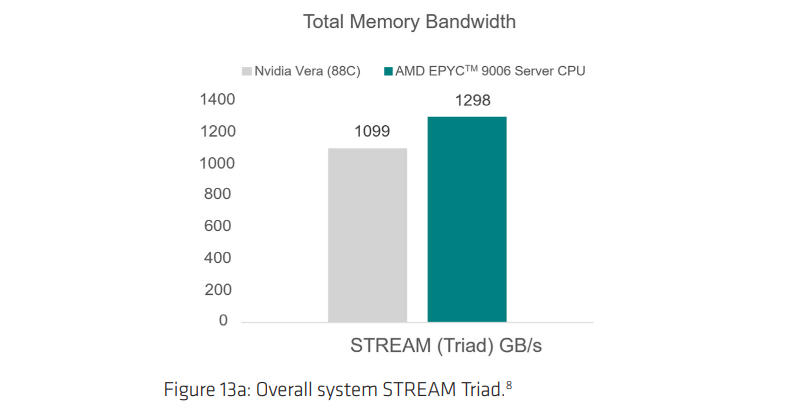
In the STREAM test, which evaluates memory bandwidth, AMD again used the Epyc 9996, reducing the number of active cores to 96 and setting a 600 W energy limit. The memory bandwidth of the AMD processor is 18% higher than that of Nvidia Vera. When converted to a single core, the advantage is 8%. in the previous Phoronix test Vera in STREAM was significantly better than competing processors available at the time.
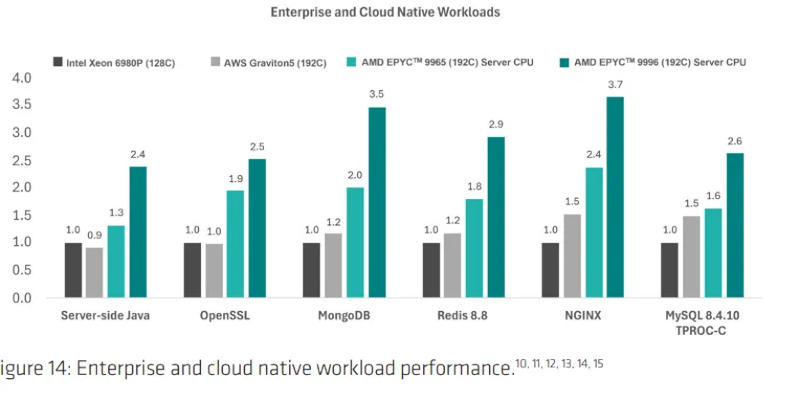
AMD also demonstrated the performance of Epyc 9996 in cloud and enterprise workloads including databases, Java applications and encryption algorithms. Here, the company primarily compares the new product to its previous-generation Epyc processors. AMD conducted these tests independently, and data for Amazon Graviton5 was obtained by testing AWS cloud execution instances.
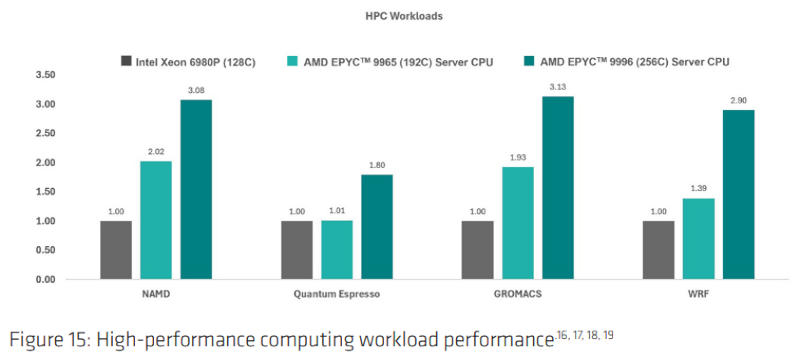
In high-performance computing tasks, Epyc 9996 also outperforms Intel’s flagship Granite Rapids-AP generation processors. Intel’s new generation of Diamond Rapids server processors will be launched in 2027.
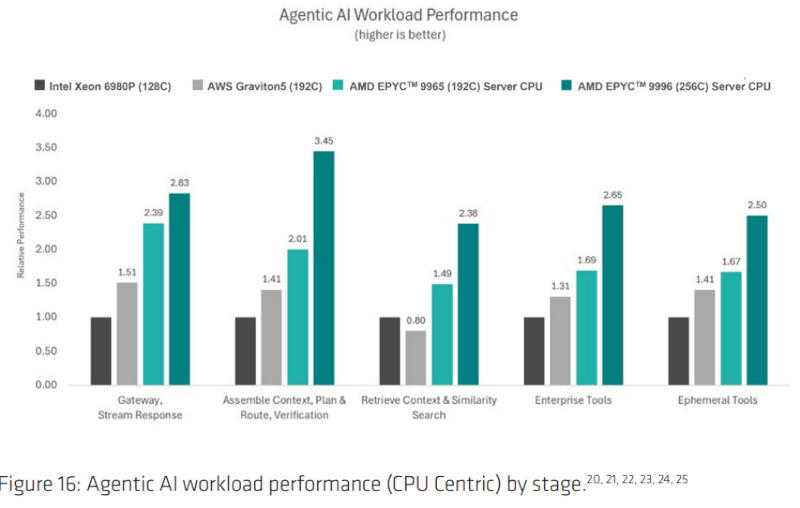
Finally, AMD showed results from a so-called agent AI workload. Testing included simulations of the NGINX web server, TPCx-AI test suite, FAISS vector search engine, TPC-H and TPC-C derived workloads, and multiple AI agents with different roles. Load results from TPC-H and TPC-C are not directly comparable to the official published performance of these benchmarks.
The tests provided by AMD show that Epyc Venice is a significant improvement over the previous generation, but don’t allow us to draw equally clear conclusions about its superiority over the competition: configurations, sources, and testing conditions vary. Additionally, the results from Zen 6c server processors may not be directly transferable to future consumer chips using the Zen 6 architecture.
If you find an error, select it with your mouse and press CTRL+ENTER.