



Researchers at the University of Groningen in the Netherlands have discovered why a promising solar panel material can retain the energy of “hot” electrons about 1,000 times longer than usual. The discovery could help push the theoretical limits of solar cell efficiency, which has long been estimated to be around 33%.

Image source: Chelsea/Unsplash
Solar panels convert sunlight’s energy into electrical energy using photons, which transfer energy to electrons. The highest-energy photons create so-called “hot” electrons, which can generate more electricity, but they almost immediately lose the excess energy in the form of heat. It is this rapid cooling that prevents the extra energy from being used efficiently. The new work continues research into a promising tin-based material in which the process of cooling “hot” electrons is shown to be about 1,000 times slower.
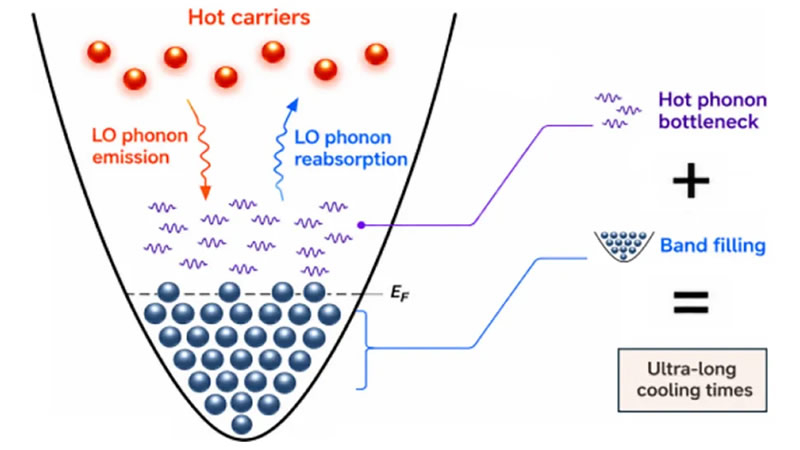
Image source: Faber et al., ACS Energy Letters, 2026
The researchers found that the material’s unusual behavior can be explained by the simultaneous action of two physical effects. The first is called the phonon bottleneck. As a result, the environment around the electrons heats up rapidly, and then the electrons begin to reabsorb heat energy and maintain high temperatures for longer. The second effect, known as the Burstein-Moss effect, creates traffic jams in available energy levels because cooling electrons quickly fill empty spaces at lower energy levels, blocking the paths of other electrons.
As a result, it becomes more difficult for other “hot” electrons to give up their energy and move to lower energy levels. Scientists compared the process to passengers boarding an airplane: the first ones sit in the seats at the front, while everyone else has to make their way deeper into the cabin. Physicists have known about both effects earlier, but a new study shows that it is their combined effect that allows the material to significantly extend the cooling time of “hot” electrons.
The researchers say the combination of necessary electronic, phonon and chemical properties under intense illumination of the material creates the conditions for ultralong cooling, which could potentially be used in devices. If this approach could be applied to solar cells, it could increase sunlight conversion efficiency beyond the long-established theoretical limit of 33%. Detailed information about research published in the journal ACS Energy Lettersthe publication reported Technology Radar.
If you find an error, select it with your mouse and press CTRL+ENTER.