


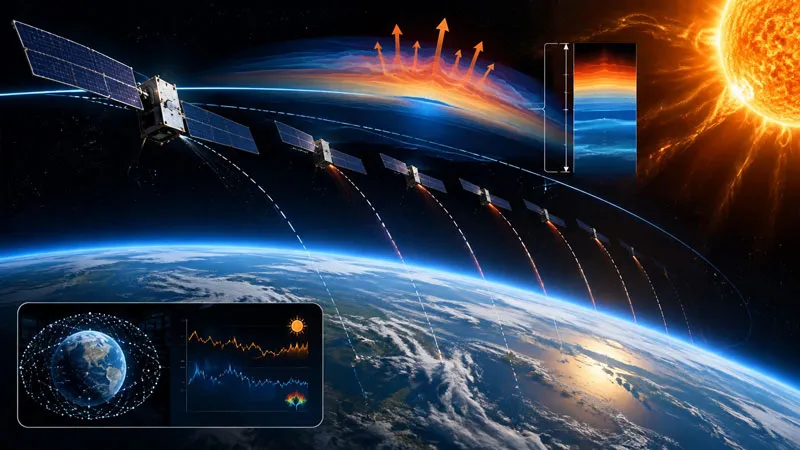
Astronomer and nonfiction author Tony Phillips suggestion Using a megaconstellation of satellites in low Earth orbit as global sensors of the state of Earth’s upper atmosphere. Satellites are constantly experiencing braking from the sky, and the rate at which their orbits fall depends on the density of gases at altitudes hundreds of kilometers. Satellite Orbit Change Analysis is a free solar activity sensor.
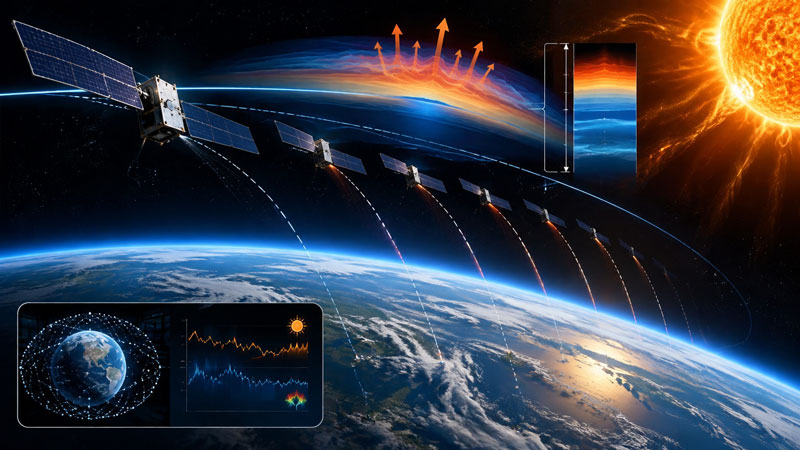
Image source: AI Generation ChatGPT/3DNews
This method is based on TLE (Two Line Elements) data – an open orbital parameter set published by the United States Space Command. Each such set contains a parameter B* (“binary”) related to atmospheric drag. Orbital models assume a certain density in the atmosphere, and if the actual atmosphere became denser, the satellite would move much slower than expected. The orbit calculation algorithm then increases the value of B* to compensate for the difference. In this way, the value of B* becomes an indirect indicator of air density in satellite orbit, and this data is completely open to everyone.
When the sun becomes more active, its ultraviolet radiation heats the thermosphere, the layer of the atmosphere at altitudes of about 90 to 600 kilometers. The gas expands upward, and the satellite begins to experience greater drag. As a result, their orbits fall faster. Phillips said the rate of this “dip” is related to solar radio emissions with a wavelength of 10.7 centimeters, and that the atmosphere’s reaction occurs about two days after the change in solar activity: gas is a slow material that expands when heated. Another example is a geomagnetic storm, which causes a sharp increase in atmospheric density and accelerates a satellite’s descent.
To improve the reliability of this method, the researchers not only analyzed the Starlink constellation. The calculation includes about 1,000 Starlink satellites, 107 Planet Labs SuperDove satellites, 391 Amazon Kuiper satellites and 651 Eutelsat OneWeb satellites. Different orbital altitudes allow comparison of the response of different atmospheric layers. The result is a decentralized weather station without any new scientific instruments: the satellites themselves become the sensors, and their orbital movements become a set of scientific data.
At the same time, the proposed method has limitations: satellites can perform maneuvers, change direction, turn on engines to correct their orbit, and TLE data is less accurate than dedicated scientific measurements. However, the large number of devices makes it possible to statistically separate individual changes from general processes in the atmosphere. Such a “barometer” could help improve space weather forecasts, improve satellite risk assessments, and study the upper atmosphere’s response to solar storms.
If you find an error, select it with your mouse and press CTRL+ENTER.


![There are 2 games coming to Game Pass today – Premium and Basic [25 сентября]](https://www.aroged.com/wp-content/uploads/2026/09/There-are-2-games-coming-to-Game-Pass-today-360x180.jpg "There are 2 games coming to Game Pass today – Premium and Basic [25 сентября]")