


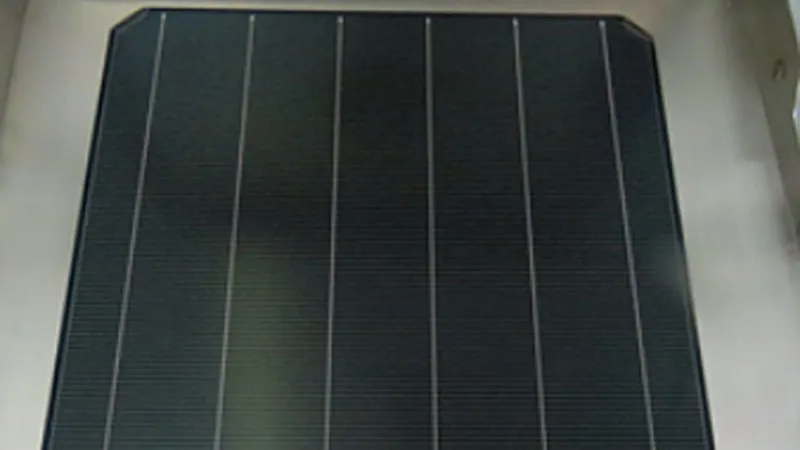
Chinese company Longi Installed Classic single-junction silicon solar cells set a new world efficiency record, achieving a solar light conversion rate of 28.29%. The results were confirmed by independent tests at the German Solar Energy Research Institute (ISFH) in Hameln and come closer than ever to the theoretical limits of this type of cell.
Image source: LONGi Corporation
The recording unit is manufactured according to the HIBC (Hybrid Interdigital Back Contact) architecture, a hybrid design with a thin film contact track on the back of the panel (in English literature such contacts are called “fingers”). Unlike traditional solar cells, where metal electrodes partially cover the front surface and reduce the light-absorbing area, HIBC transfers both types of electrical contacts to the back of the panel. This allows you to increase the effective lighting area while reducing losses due to charge carrier recombination.
This device is based on a high-resistance silicon wafer in the M10 format (182 × 182 mm), using edge passivation technology and optimized n-junctions. To improve charge transport, LONGi uses an indium tin oxide (ITO) layer as well as aluminum oxide (AlOx) and silicon nitride (SiNx) multi-layer coatings to reduce surface recombination. In addition, engineers lowered the phosphorus concentration in the polycrystalline n-type silicon layer to limit the diffusion of impurities into the silicon, and special deep grooves for metal contacts help prevent leakage between the n-type and p-type regions.
In order to reduce the contact resistance without affecting the passivation properties (preventing chemical and physical activity on the material surface), the researchers used laser processing: a pulsed green nanosecond laser was used to partially crystallize the amorphous silicon layer. Longi said that HIBC technology can be used for the industrial production of heterojunction solar cells, but further improvement in efficiency will require reducing ohmic losses, especially in the p-junction area. The company estimates that current silicon cells have reached about 96.2% of their theoretical efficiency limit, so further progress will depend on extremely precise optimization of materials and device structure.
Earlier this year, the company also set a new record for single-junction silicon photovoltaic panel efficiency, which continued to increase from 28.04%, 28.13%, and finally rose to 28.29%. LONGi is also approaching the theoretical efficiency limit of tandem silicon and perovskite solar cells, reaching 34.6% efficiency, but that’s another story.
If you find an error, select it with your mouse and press CTRL+ENTER.