

Google has launched Gemini 4 Argon, a flagship artificial intelligence model designed to solve complex multi-step tasks in programming, data analysis, law and finance, and cybersecurity. But more importantly, the new model is Google’s attempt to get back into the artificial intelligence race, where it has recently lagged behind OpenAI and Anthropic.
Gemini 4 was released almost a full year after Gemini 3 Pro, which was only updated to Gemini 3.1 Pro in February during this period. So Google was seriously behind its competitors: OpenAI launched GPT-6 Astra, Anthropic brought Claude Fable 5 and Mythos 5 to market, and then 5.1. Now, Google has an answer in the form of the Gemini 4 Argon, which the company itself is positioning to be at the level of its rivals’ advanced models.
Gemini 4 Argon received a withdrawal limit of up to 1 million tokens – something Google says is an industry record. By comparison, the company’s previous model generated a maximum number of 64,000 tokens in response. This margin allows the model to perform longer chains of inference and produce hundreds of thousands of tokens in a single workflow.
Google describes Gemini 4 Argon as a system that not only answers questions or generates a piece of code, but also examines raw files, makes plans, runs necessary tools, examines intermediate results, and corrects its own errors.
The main areas of application for Gemini 4 Argon are software development, financial and legal work, and cybersecurity. Google already uses Argon internally. In particular, model-based agents help optimize quantum computing algorithms, analyze data center telemetry, and automatically find ways to reduce memory consumption. After implementing the recommended optimizations, the company expects to free up more than 300 TeB of memory and estimates the potential total impact to be 500 TiB – 1 PiB.
Another direction is the large-scale migration of program code from C and C++ to Rust. Argon is used to handle code bases ranging from tens of thousands to over 800,000 lines in the Fuchsia OS core. In one experiment, the model agent processed 32,000 lines of SIMD code from the libgav1 video decoding library. The resulting Rust implementation is 2.7 times faster than the previous Rust port, with the same decoding results.
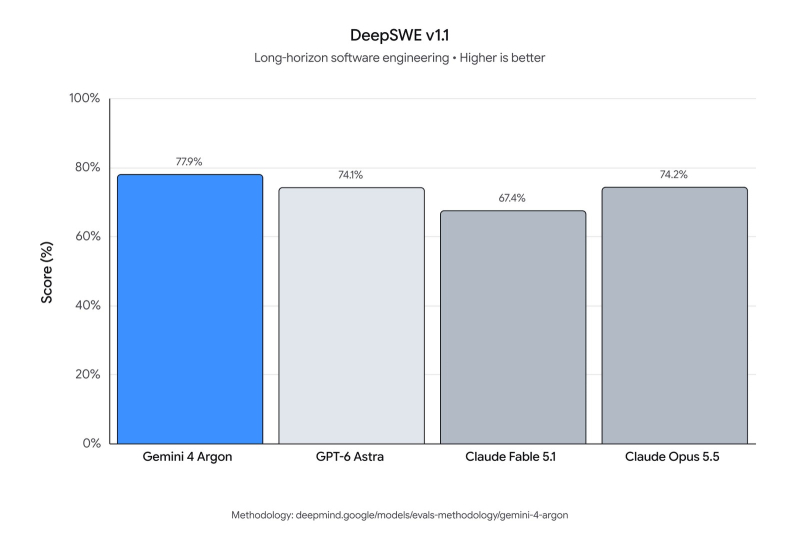
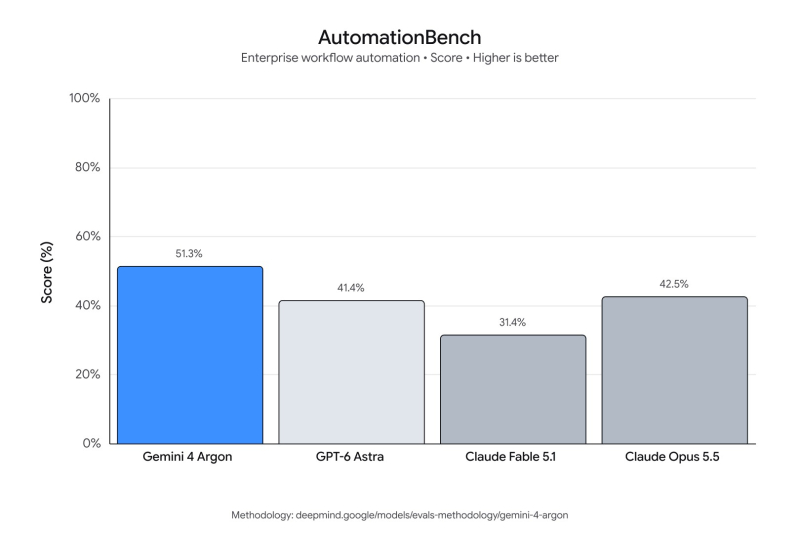
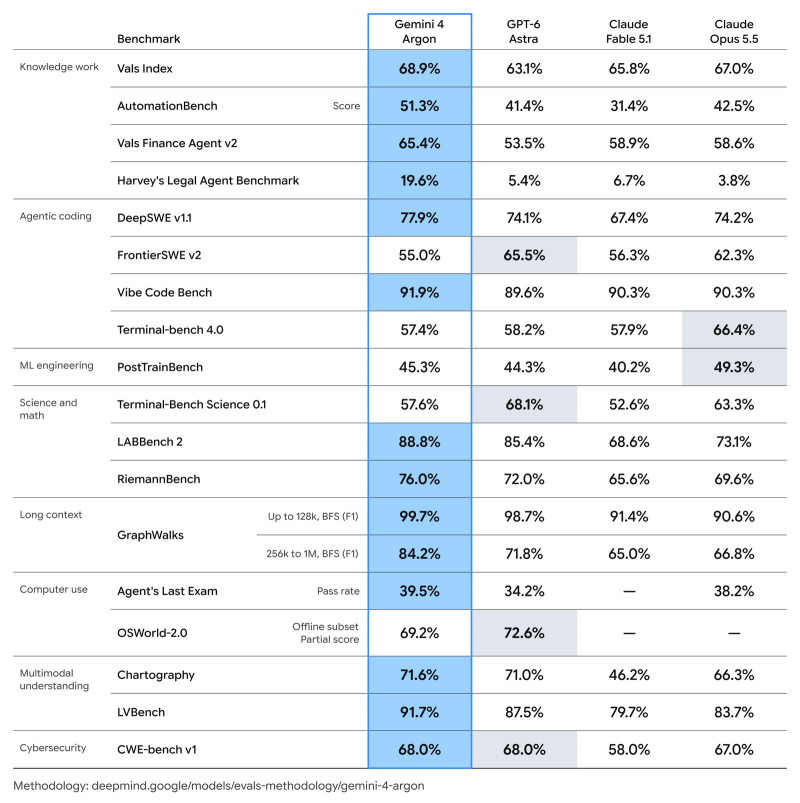
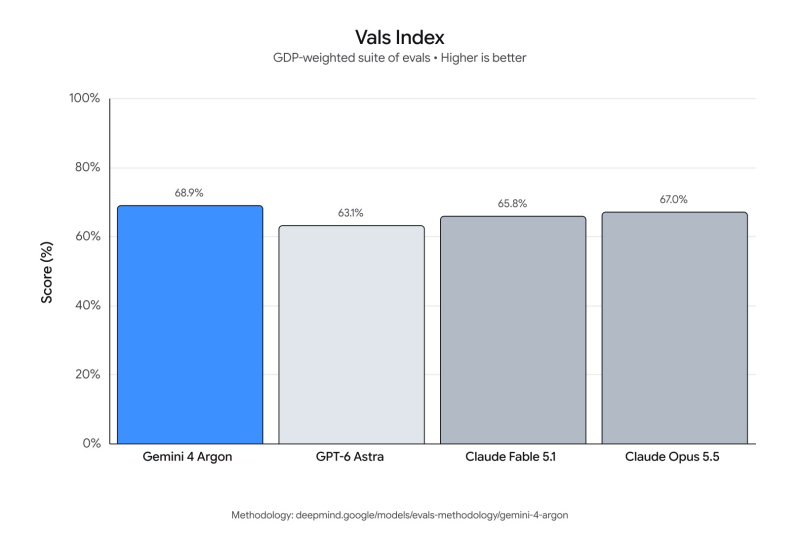
In Google’s own testing, Gemini 4 Argon achieved a score of 77.9% on the DeepSWE v1.1 benchmark, which evaluates artificial intelligence’s ability to solve real-life, long-term software development problems. This is higher than the performance of GPT-6 Astra (74.1%) and Claude Fable 5.1 (67.4%). In AutomationBench, which checks whether agents are executing multi-step business processes correctly, the new product received a 51.3% rating, compared with They are “Astra” and “Fable”. Argon also leads the flagship GPT-6 Astra and Claude Fable 5.1 in the Vals index. In the LVBench long video comprehension test, the score was 91.7%.
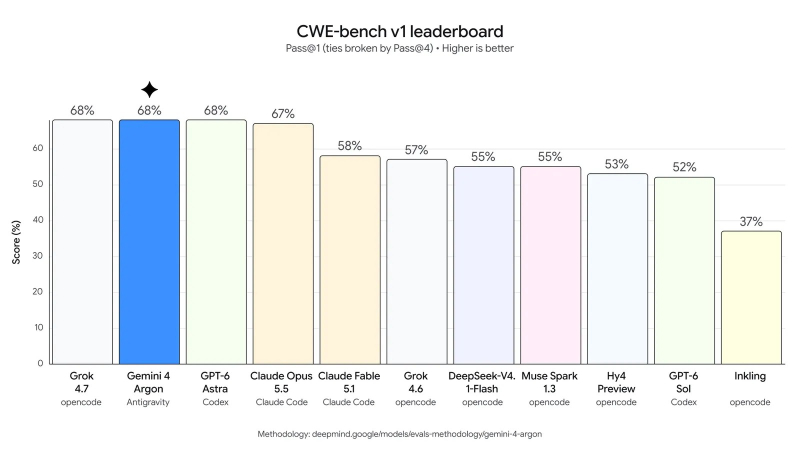
Google is particularly interested in Argon’s capabilities in the field of cybersecurity. The model can independently search, inspect and fix software vulnerabilities. In the CWE-bench v1 test, it achieved a score of 68%, tied for first place with the flagship GPT-6 Astra and Grok 4.7. Google also claimed that Argon was significantly better than Gemini 3.8 Flash Cyber in multiple internal tests for web system vulnerability detection and analysis.
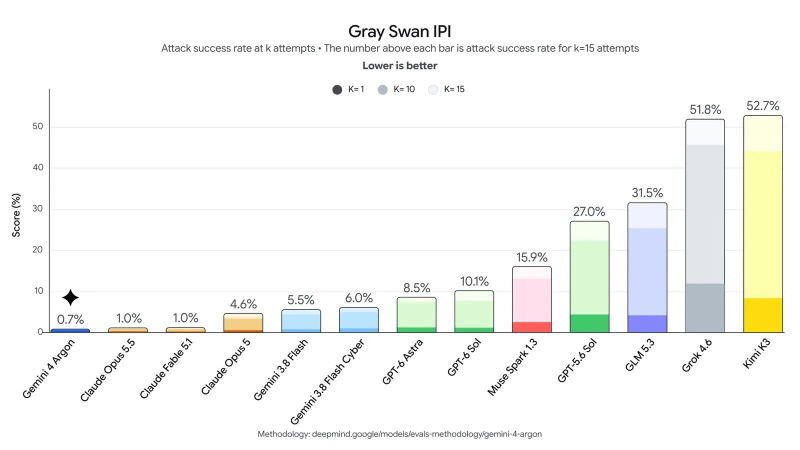
Google has no immediate plans to publicly release Gemini 4 Argon. It will first be tested by trusted cybersecurity experts through the Fairwind program. Google also tested Gemini 4 Argon’s resistance to malicious commands, attempts to trick the AI, and agent overruns.
Once testing is complete, Google plans to make Argon available to developers, enterprise customers, and consumers — starting with paying API customers and Google AI Ultra subscribers. Initially, using the model will cost $2 for 1 million input tokens and $10 for 1 million output tokens; after the introductory period, the rates will increase to $4 and $20 respectively. The price of cache input tokens will be 95% lower than the standard price.
If you find an error, select it with your mouse and press CTRL+ENTER.