



Roscosmos demonstrated visualizations of objects observed by the Russian ART-XC telescope operating in the hard X-ray range. The space agency talked about an autonomous navigation system based on signals from pulsars.
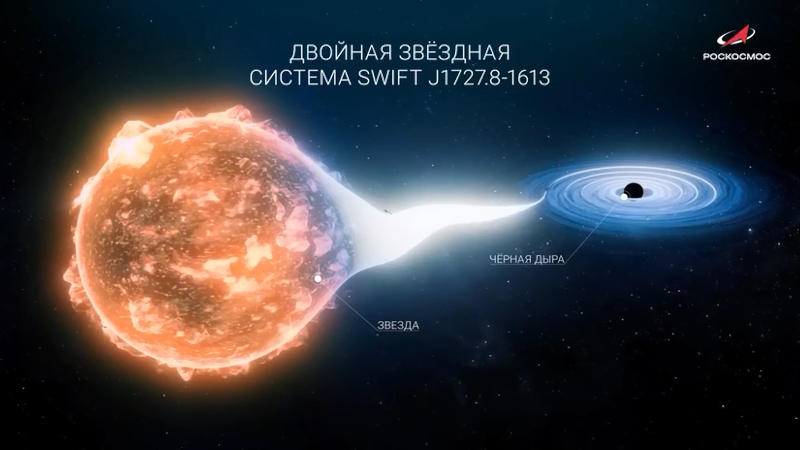
Image source: roscosmos.ru
The Russian ART-XC telescope is named after M. N. Pavlinsky, an outstanding Russian scientist in the field of X-ray astronomy and space instrumentation. The device is installed on the Spektr-RG space observatory, which is located in the vicinity of the L2 Lagrange point of the Sun-Earth system, approximately 1.5 million km from the planet. To date, the telescope has completed eight complete surveys of the sky. Roscosmos Media, together with ART-XC specialists, held visualization in the visible range of several objects detected by the telescope.
The binary system Swift J1727.8−1613 consists of a black hole and a companion star, the material of which is pulled towards itself by the black hole, forming a hot accretion disk. The ultra-dense neutron star SRGA J144459.2−604207, an accreting millisecond X-ray pulsar, rotates at colossal speed. ART-XC recorded the early stages of the supernova explosion SN 2023ixf in the M101 galaxy.
The supermassive black hole SRGA J230631.0+155633 is a distant quasar that is actively absorbing material from a bright accretion disk. The object is hidden by a dense torus of dust and gas that glows in the X-ray range. “Hercules X-1” is an X-ray source located in our galaxy, which is a classical binary system with a flow of matter falling onto the surface of a neutron star and causing thermonuclear explosions at its poles.
Another goal of ART-XC is to study the possibilities of autonomous navigation of spacecraft. Signals from isolated pulsars can act as “beacons”. In the future, this technology will give devices the ability to independently determine their position in deep space in the absence of constant communication with the Earth.
If you notice an error, select it with the mouse and press CTRL+ENTER.


