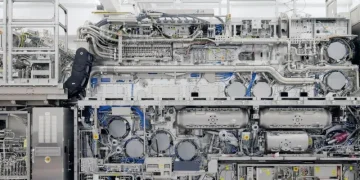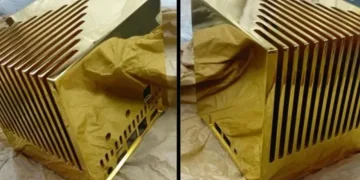



Scientist at UCLA developed An unusual optical system called a recumbent mirror. Unlike a regular mirror, it doesn’t simply reflect the light that falls on it, but transforms it into a completely different, pre-selected image. They say it’s the camouflage of the future, requiring no batteries or electronics to work.

Image source: AI Generation ChatGPT/3DNews
The technology is based on structured diffractive surfaces with microscopic elements that change the phase of reflected light. The geometry of these elements is calculated using deep learning methods: during the design process, algorithms select surface structures so that any input image produces a specified result after reflection. Once manufactured, the mirror does not require a computer, monitor or power supply – the image is transformed directly by the interference of light. In this respect, the principle is similar to that of holography, but the recovery of the recorded image does not occur under the influence of a powerful point source of light, but actually occurs under the influence of many rays of light incident on it, including those reflected from the observer.
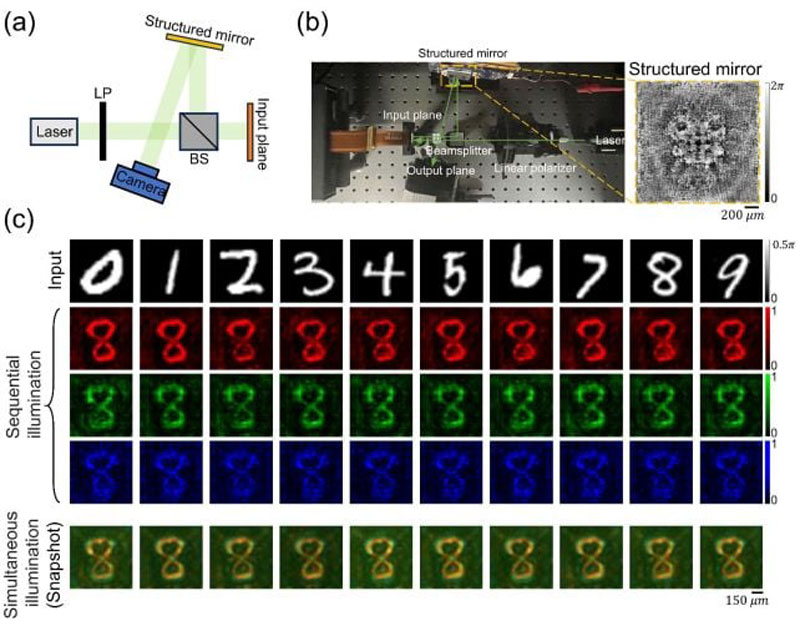
Image source: Nature 2026
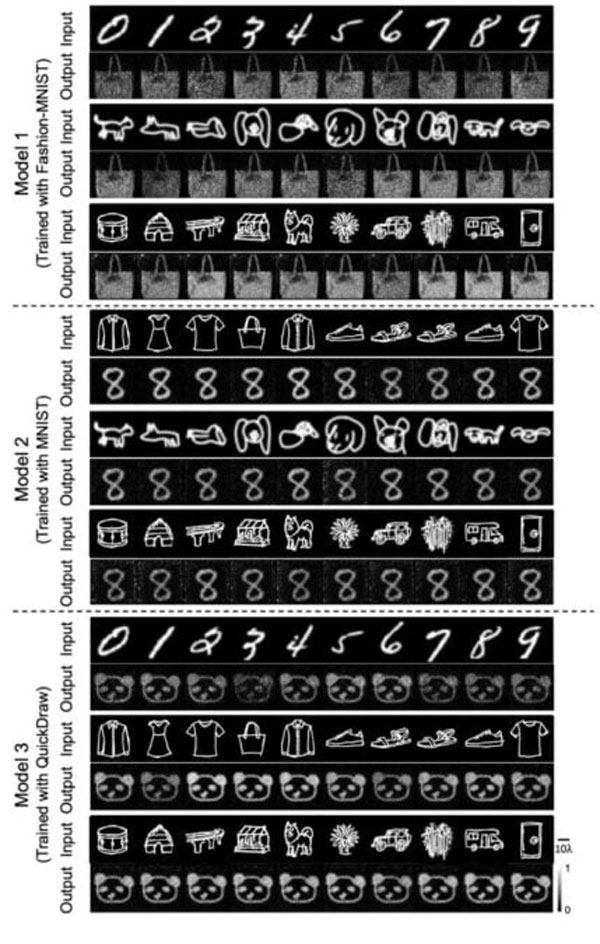
The prototype created by the scientists works at wavelengths of 480, 550 and 600 nm, corresponding to the blue, green and red channels, and conversions of each color can be obtained individually or by mixing them. The authors have also developed a broadband version designed for continuous wavelengths. “Lying Mirror” turns images of clothes into bags, various numbers into eights, and simple drawings into panda faces.
Technology is still far away from a “magic mirror” that can actually be hung on the wall. The experiment was conducted under tightly controlled laboratory conditions, with coherent illumination and a given direction of incident light, whereas sunlight and ordinary indoor light are largely incoherent and arrive at many random angles. It is likely that more complex multi-layered volumetric structures will be needed to fool the eye in real environments.
In the future, the presented principle could be used for optical camouflage: instead of simply hiding the object, a surface could replace its image with something visually inconspicuous. Among other possible applications, the authors mention security systems, protection technology and entertainment.
If you find an error, select it with your mouse and press CTRL+ENTER.