


It is no secret that supermassive black holes at the centers of galaxies seriously affect the evolution of galaxies. Energy emissions from winds and jets generated by active black holes light up and extinguish stars in vast native galaxies. But scientists made serious mistakes in assessing this impact. new job showActive supermassive black holes can mix matter and even influence their neighbors within a distance of up to three galactic disks.
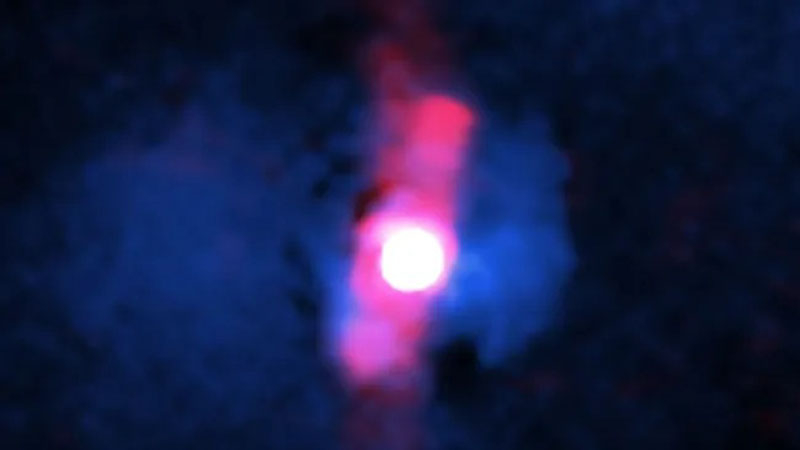
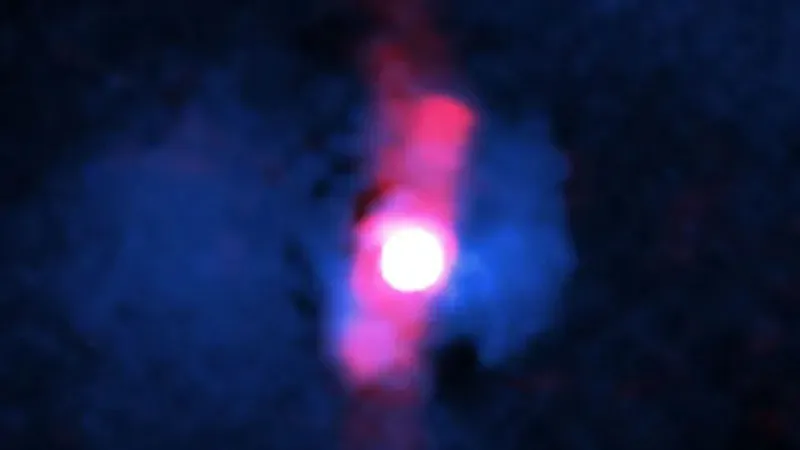
Composite image of quasar H1821+643. Image source: NASA
Japanese astronomers reported the discovery after conducting a series of observations of the quasar H1821+643. They found that the supermassive black hole had an unusually powerful impact on the surrounding space: the quasar’s energy caused hot gas to bubble up to 300,000 light-years from its center, making it turbulent. That’s about three disks of the Milky Way, apparently far beyond the host galaxy.
The quasar is located in the constellation Draco, about 3.4 billion light-years away from Earth and at the center of a galaxy cluster. The black hole’s mass is estimated to be about 2.6 billion solar masses.
Key data were obtained by the Japan-US X-ray Observatory XRISM, which observed H1821+643 from September 4 to 10, 2024. The scientists focused on studying the spectral lines of highly ionized iron, i.e. how the ions of this element behave under the influence of energy flows at all distances from the quasar. The average gas speed in turbulent flow reaches 300 kilometers/second, and the plasma temperature reaches 72 million degrees Celsius.
Strong gas motions were recorded in the periphery of the quasar, which is 300-330,000 light-years away. To put this into perspective, this effect is equivalent to the energy of billions of supernova explosions and is two orders of magnitude greater than all previous estimates of the impact of supermassive black holes on the material around them. The results clearly show that active black holes are not only capable of ejecting material from galaxies, but can also directly heat and mix gas throughout the cluster’s core, thereby affecting the cooling of material, the formation of new stars, and the further evolution of surrounding galaxies hundreds of thousands of light-years away.
If you find an error, select it with your mouse and press CTRL+ENTER.