


Apple has launched two new processors for Mac computers – M6 and M5 Ultra. The first became the company’s first 2nm chip for mass systems, and Apple calls the M5 Ultra “the most powerful chip in the company’s history.” It focuses on resource-intensive professional tasks, including 3D rendering, video processing, and running large artificial intelligence models locally.
Image source: Apple
M6 is Apple’s first chip produced using the 2nm process. The company said the transition to new technologies has increased transistor density while improving performance and energy efficiency. The chip is equipped with two 16-core neural engine modules designed to accelerate artificial intelligence tasks directly on the device.
The M6 CPU has 12 cores, two more than the M5. It consists of two super cores, four high-efficiency cores, and six energy-saving cores. According to Apple, the M6 delivers the world’s fastest single-thread CPU performance, up to 1.2 times faster than the M5 in multi-threaded tasks.
The M6 GPU also has 12 cores, two more than the M5. Each product has a built-in dedicated neural accelerator, which improves the peak GPU computing performance of AI workloads by nearly 30% compared to M5. In addition, Apple has also updated the shader core architecture, dynamic cache technology, and hardware acceleration for ray tracing. Geometry processing speed increased by 50%.
M6 supports up to 32GB of unified memory and a bandwidth of up to 170GB/s, which is 10% higher than M5. The new processor debuts in the updated Mac mini. As previously reported, Apple will skip the release of M6 Pro or M6 Max models. Instead, the company will move directly to the M7 in mid-2027.
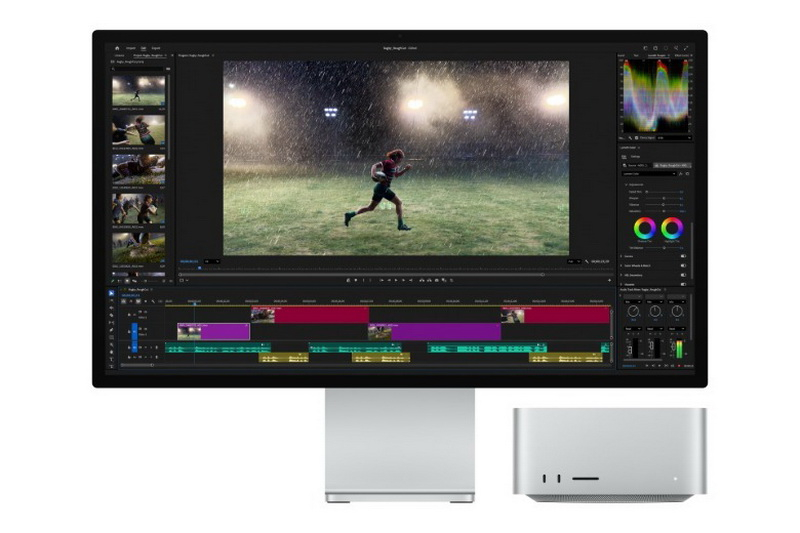
At the same time, Apple launched the M5 Ultra, which will be used in the new Mac Studio. The chip is produced using 3nm technology, making it the first four-chip processor in the Apple Silicon family. The company used UltraFusion technology to merge two dual-chip M5 Max into one processor. Die-to-die throughput exceeds 4.4 TB/s and interconnect density increases by more than six times. According to Apple, this allows four dies to act as a single processor.
The M5 Ultra has up to 36 CPU cores, including 12 super cores and 24 performance cores. Compared with M3 Ultra, single-thread performance is improved by up to 25%, and multi-thread performance is improved by up to 30%.
The M5 Ultra graphics subsystem has up to 80 cores, each equipped with its own neural accelerator. As a result, the peak GPU computing performance in AI tasks is 4.5 times higher than M3 Ultra and more than 6 times higher than M1 Ultra. For traditional graphics tasks, Apple promises up to 40% performance improvement compared to the M3 Ultra.
The M5 Ultra also features support for up to 512 GB of unified memory with a bandwidth of 1.2 TB/s – 50% higher than the M3 Ultra. This volume makes it possible to fully accommodate large language models with hundreds of billions of parameters in system memory and run them locally.
The M5 Ultra also features a 32-core Neural Engine and an updated media engine, with hardware support for H.264 and HEVC, four ProRes encoding and decoding units, and hardware AV1 decoding. Apple said the new processor combines the company’s leading performance with high energy efficiency.
If you find an error, select it with your mouse and press CTRL+ENTER.