


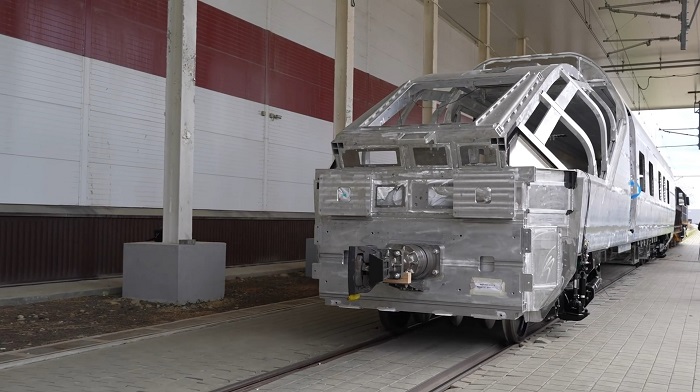
Take into account the speed limits and general load of the Moscow-St. Petersburg train. The St. Petersburg High-Speed Railways (HSR) will operate for decades, and there is reason to believe that they have a huge safety margin. Well, to check this, there are appropriate tests, some of which spend “Russian Railways” (RZD).
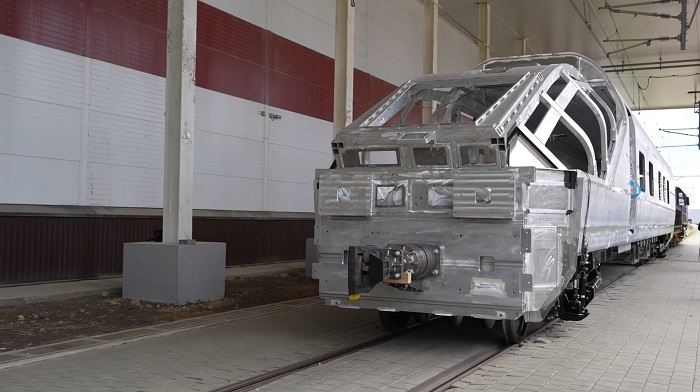
Image source: Russian Railways, Ulla Locomotive, Russian Ministry of Transport.
As mentioned above, as part of the testing, the lead and intermediate cars of future high-speed trains will be subjected to impact tests. The essence is this: a crash car of different masses hits the test car at different speeds in 20-ton increments. The task is to ensure that the car does not undergo severe deformation after testing and demonstrates the ability to absorb impact energy without affecting passengers.
The results are recorded by numerous sensors capable of detecting the smallest deformations of the car’s structure: from the body itself to the frames, window and door openings and more.
Let us remind you of the full sea trials of the Moskva-St. Petersburg. St. Petersburg’s high-speed rail and high-speed trains are scheduled to open at the end of next year. The first truly high-speed railway in Russian history will carry passengers in spring 2028. Unless, of course, the plan encounters obstacles in its implementation.