


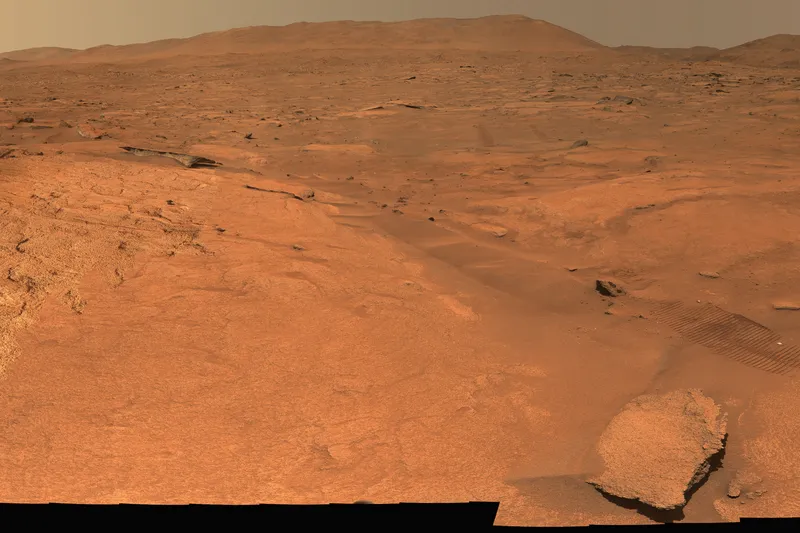
New data from NASA’s Perseverance rover showThe rim cell region on the inner rim of Jezero Crater has experienced a much more complex history of interactions with water than orbital observations suggest. Scientists had expected to find sedimentary rocks from an ancient lake here, but the rover found three options for the influence of water on igneous rocks – internal and external. Water was ubiquitous at that time, leading people to believe that Mars was once a habitable world.

Image source: NASA
At the top of the Rim Unit geological formation (the name given to it by the rover team), about 265 m above the lowest part of the explored crater area, Perseverance found coarse-crystalline material containing olivine with minimal signs of interaction with water. This structure shows that magma slowly cooled and rose from the depths of Mars. It came to the surface when there was almost no water on Earth.
However, as the height of the formation decreases, the properties of the rock change: the olivine crystals are destroyed and the spaces between them are filled with silica. Of particular importance is the presence of carbonate and silicate minerals. On Earth, the reaction of olivine with water can release hydrogen gas, which may become an energy source for microorganisms, while forming carbonates and silicon dioxide, which may be indirect signs of ancient life.

View of the geological formation being studied
The igneous rocks appear to interact with circulating groundwater rich in carbon dioxide. Neutral or slightly alkaline water flows penetrate cracks in the olivine rock, promoting the formation of carbonates, which are subsequently preserved as stable ridges after the surrounding material is destroyed. In other words, Mars’ soil is filled with water and may be suitable for microbial life to flourish.
Another sign of water activity in the area seems to be related to ancient Lake Jezero or changes in the composition of groundwater: carbonates are partially redistributed and silica is precipitated in mineral pores. Meanwhile, Perseverance examined more than 185 bedrock outcrops using SuperCam, a complex capable of remotely vaporizing material using lasers at distances of up to 6.5 m and analyzing the chemical composition of the resulting plasma.
Finally, a third indication of possible water interactions in the area comes from traces of hot water seeping out of younger cracks. In the eastern part of the edge unit, a vein about 25 cm thick was discovered, containing calcium sulfate and fluorite. The latter is especially important: On Earth, fluorite is typically formed when hot water circulates through volcanic rock.
Marginal units are thus effectively a kind of geological archive, which successively preserve traces of groundwater, ancient lakes, and later hydrothermal systems. The age of the individual events cannot yet be determined, but the sequence of interactions itself provides new material for reconstructing the climate, water cycle, and potential habitability of early Mars.
If you find an error, select it with your mouse and press CTRL+ENTER.