





The most interesting thing about the comments
Today’s wearable smart devices are quite concentrated in form, but advances in the field of nanotechnology will lead to our clothing also gaining certain functions from an information technology perspective. For example, scientists at the University of Illinois successfully developed 3D printed fabrics. allow Both effectively reflect the sun’s heat and generate electricity.

Image source: Unsplash, Cai Shengpengpeng
Researchers from the Grainger School of Engineering have successfully created a zirconia composite material that could be used in sportswear and more. In a static state, materials applied to textile substrates can reflect up to 96% of solar radiation, thus preventing parts of the human body under clothing from heating up. It can also effectively dissipate the body’s own heat through infrared radiation: up to 97% of the heat generated by the human body lies in the mid-infrared spectrum. The material can also accumulate static electricity generated during human movement in sufficient quantities to operate a small sensor. It’s impossible to power any serious electricity consumer using the suit, but the pulses a person receives when moving in the suit could serve as a signal to start other processes. For example, sensors could signal certain motor activities of a person wearing pajamas at night. The data could be used both to monitor sleep quality and to care for young children or the elderly as an alternative to a baby monitor.
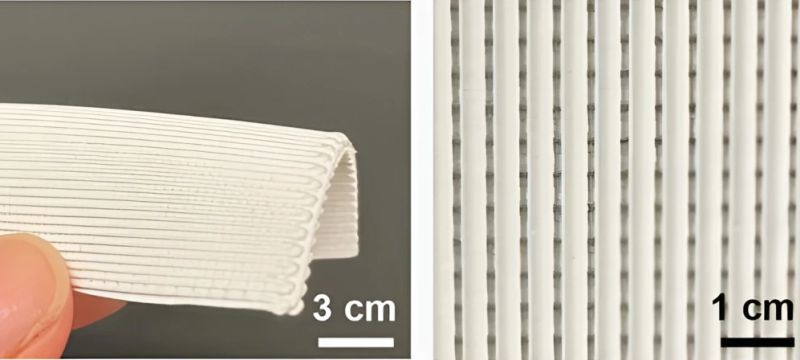
Image source: University of Illinois at Urbana-Champaign
Experiments have shown that clothes made of this material are 3-6 degrees Celsius cooler than the ambient temperature. This is a pretty significant difference since the average person can feel a 1 degree Celsius change in temperature. The new material is also very convenient from a manufacturing perspective, as it can be applied to textile substrates via 3D printing. Its power generation capacity is expressed as a peak energy density of 47 mW/m2durability is determined by more than 30,000 cycles. The developers used the material as part of an experimental garment equipped with a heating system activated by the start of human movement signals from specific “nanotextiles”. The heating system is powered by other energy sources and equipped with a control system based on the Arduino platform.
Tell Google about this to receive more frequent links to our news on technology and IT markets
If you find an error, select it with your mouse and press CTRL+ENTER.